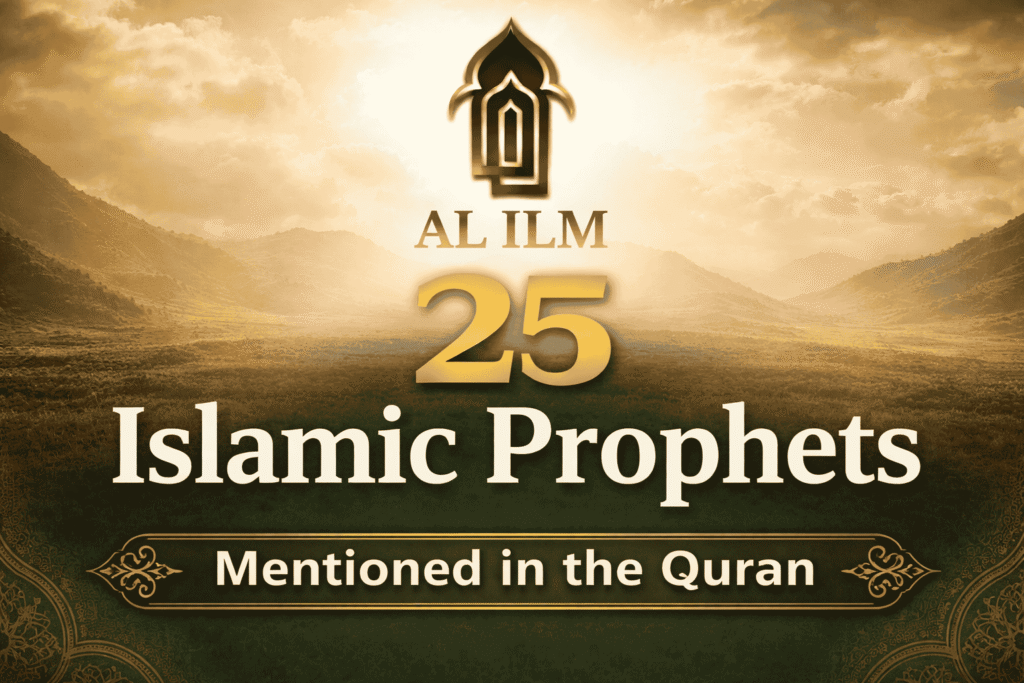
The Quran mentions 25 prophets by name, while also making clear that Allah sent other messengers whose stories are not all detailed in the Quran. Islamic scholarship commonly points to these 25 named prophets as the best-known prophetic list in the Quran.
The 25 prophets mentioned in the Quran are: Adam, Idris, Nuh, Hud, Salih, Ibrahim, Lut, Ismail, Ishaq, Yaqub, Yusuf, Ayyub, Shuayb, Musa, Harun, Dhul-Kifl, Dawud, Sulayman, Ilyas, Alyasa, Yunus, Zakariya, Yahya, Isa, and Muhammad.
Below is a complete and SEO-friendly guide to the 25 Islamic prophets mentioned in the Quran, with one key ayah for each prophet, its English meaning, and selected other ayahs where the prophet is mentioned. These extra references are selected, not exhaustive, so the article stays readable and useful for students, teachers, and readers.
1. Prophet Adam (AS)
Prophet Adam (AS) is recognized in Islam as the first human being and the first prophet of Allah. Allah created Adam from clay and honored him with knowledge that was not given to the angels. Adam and his wife Hawwa (Eve) initially lived in Paradise but were later sent to Earth after being tempted by Shaytan.
However, Adam sincerely repented, and Allah forgave him, teaching humanity the importance of repentance and forgiveness. Adam’s story in the Quran emphasizes the value of knowledge, obedience to Allah, and the constant struggle between human weakness and divine guidance.
Adam’s life marks the beginning of human history and the start of Allah’s guidance through prophets.
Primary Ayah
Quran 2:31
“And He taught Adam the names of all things; then He showed them to the angels and said, ‘Tell Me the names of these if you are truthful.'”
Other Ayahs
2:34-37
7:11-27
20:115-123
38:71-76
2. Prophet Idris (AS)
Prophet Idris (AS) is among the earliest prophets mentioned in the Quran and is widely known for his truthfulness, wisdom, and devotion to Allah. Islamic tradition associates Idris with knowledge, writing, and deep reflection about the universe.
He lived among people who had begun to stray from the teachings of earlier prophets, and he called them back to the worship of Allah and righteous living. Idris was known for his patience and his strong dedication to prayer and good deeds.
The Quran also mentions that Allah raised Idris to a high rank, which scholars interpret as both spiritual and physical elevation. His story reminds believers that sincere faith, honesty, and dedication to knowledge bring honor in the sight of Allah.
Primary Ayah
Quran 19:56
“And mention in the Book Idris. Indeed, he was a man of truth and a prophet.”
Other Ayahs
21:85-86
3. Prophet Nuh (AS)
Prophet Nuh (Noah) (AS) is one of the most frequently mentioned prophets in the Quran. He was sent to guide his people who had fallen into idol worship and corruption. For hundreds of years, Nuh patiently invited them to worship Allah alone, but only a small number believed in his message.
Despite facing ridicule and rejection, Nuh remained steadfast in his mission. Allah eventually commanded him to build an ark as a sign that a great flood would come as punishment for those who rejected the truth.
Nuh’s story is a powerful example of patience, perseverance, and unwavering faith in Allah’s guidance.
Primary Ayah
Quran 11:25
“And We certainly sent Noah to his people, saying, ‘Indeed, I am to you a clear warner.'”
Other Ayahs
7:59-64
11:25-49
23:23-30
26:105-122
71:1-28
4. Prophet Hud (AS)
Prophet Hud (AS) was sent to the powerful tribe of ‘Ad, a civilization known for its strength, wealth, and impressive structures. Despite their prosperity, the people of ‘Ad became arrogant and turned to idol worship.
Hud called them to return to the worship of Allah and warned them about the consequences of their arrogance. However, most of his people rejected his message and mocked him.
Eventually, Allah punished the disbelievers with a powerful storm, while Hud and the believers were saved. Hud’s story teaches that arrogance and pride can lead to destruction, while humility and faith bring salvation.
Primary Ayah
Quran 11:50
“And to the people of ‘Ad We sent their brother Hud. He said, ‘O my people, worship Allah; you have no deity other than Him.'”
Other Ayahs
7:65-72
11:50-60
26:123-140
46:21-26
5. Prophet Salih (AS)
Prophet Salih (AS) was sent to the tribe of Thamud, a civilization known for carving homes into mountains. Although they were highly skilled and prosperous, they turned away from Allah and began worshipping idols.
Salih called them to believe in one God and presented a miraculous sign: a special she-camel sent by Allah. The people were instructed not to harm the camel, but many of them disobeyed and killed it.
Because of their rebellion, Allah sent a severe punishment upon them. Salih’s story emphasizes the importance of respecting Allah’s signs and remaining grateful for blessings.
Primary Ayah
Quran 11:61
“And to Thamud We sent their brother Salih. He said, ‘O my people, worship Allah; you have no deity other than Him.'”
Other Ayahs
7:73-79
11:61-68
26:141-159
27:45-53
6. Prophet Ibrahim (AS)
Prophet Ibrahim (Abraham) (AS) is one of the most important prophets in Islam and is often called the “Father of the Prophets.” He is known for his unwavering faith in Allah and his strong rejection of idol worship.
Even as a young man, Ibrahim questioned the beliefs of his people and challenged the practice of worshipping statues. Despite facing opposition from his community and even his own father, he remained devoted to Allah.
Ibrahim’s life includes many important events, such as the building of the Kaaba with his son Ismail, and his willingness to sacrifice his son as an act of obedience to Allah.
His story is a powerful symbol of faith, sacrifice, and trust in Allah.
Primary Ayah
Quran 2:124
“And when Abraham was tried by his Lord with commands and he fulfilled them…”
Other Ayahs
6:74-83
14:35-41
19:41-50
21:51-70
37:83-113
7. Prophet Lut (AS)
Prophet Lut (Lot) (AS) was sent to a community that had fallen into severe moral corruption and sinful behavior. His mission was to guide his people back to righteousness and the worship of Allah alone. Lut warned them about their immoral actions and encouraged them to live a life based on purity and obedience to Allah.
Despite his sincere efforts, most of his people rejected his message and continued their wrongdoing. Allah eventually punished the disbelievers while Lut and the believers were saved. His story highlights the importance of moral integrity, faith, and standing firmly for truth even when society rejects it.
Primary Ayah
Quran 7:80
“And Lot said to his people, ‘Do you commit such immorality as no one has preceded you with from among the worlds?'”
Other Ayahs
11:77–83
26:160–175
29:28–35
37:133–138
8. Prophet Ismail (AS)
Prophet Ismail (Ishmael) (AS) was the son of Prophet Ibrahim (AS) and is highly honored in Islam for his obedience, patience, and dedication to Allah. He grew up in the desert of Makkah and later helped his father rebuild the Kaaba, the sacred house of worship.
Ismail is remembered for his willingness to submit to Allah’s command when Ibrahim was ordered to sacrifice him as a test of faith. His obedience demonstrated complete trust in Allah.
Ismail later became a prophet and guided his people toward righteousness, emphasizing prayer and charity.
Primary Ayah
Quran 19:54
“And mention in the Book Ismail. Indeed, he was true to his promise, and he was a messenger and a prophet.”
Other Ayahs
2:125–129
21:85
37:101–113
38:48
9. Prophet Ishaq (AS)
Prophet Ishaq (Isaac) (AS) was the son of Prophet Ibrahim (AS) and the brother of Prophet Ismail (AS). Allah blessed Ibrahim with Ishaq in his old age, making his birth a miraculous sign.
Ishaq continued the prophetic mission of his father by guiding people toward faith in Allah. He was known for his righteousness and devotion, and his descendants continued the line of prophets.
The Quran describes Ishaq as a blessing and a mercy from Allah, highlighting the importance of gratitude and faith.
Primary Ayah
Quran 37:112
“And We gave him good tidings of Isaac, a prophet from among the righteous.”
Other Ayahs
11:71
19:49
21:72
29:27
10. Prophet Yaqub (AS)
Prophet Yaqub (Jacob) (AS), the son of Ishaq (AS), was a devoted prophet known for his patience, wisdom, and strong faith in Allah. He is also known as Israel, and his descendants formed the Children of Israel.
Yaqub’s life is closely connected with the story of his son Prophet Yusuf (AS). Despite facing the pain of losing Yusuf for many years, Yaqub remained patient and trusted in Allah’s plan.
His story emphasizes beautiful patience (Sabr Jameel) and unwavering belief in Allah during times of hardship.
Primary Ayah
Quran 12:86
“I only complain of my suffering and grief to Allah, and I know from Allah that which you do not know.”
Other Ayahs
2:132–133
12:6
21:72
38:45
11. Prophet Yusuf (AS)
Prophet Yusuf (Joseph) (AS) is known for one of the most detailed and inspiring stories in the Quran. His life story is narrated in Surah Yusuf, which describes his trials, patience, and ultimate success.
As a young boy, Yusuf was betrayed by his brothers and thrown into a well. He was later sold into slavery and imprisoned despite being innocent. Through all these trials, Yusuf remained patient and faithful to Allah.
Eventually, Allah elevated him to a position of authority in Egypt, where he forgave his brothers and reunited with his family.
His story teaches patience, forgiveness, and trust in Allah’s wisdom.
Primary Ayah
Quran 12:4
“When Joseph said to his father, ‘Indeed, I have seen eleven stars and the sun and the moon; I saw them prostrating to me.'”
Other Ayahs
12:4–101
6:84
40:34
12. Prophet Ayyub (AS)
Prophet Ayyub (Job) (AS) is known in Islamic tradition as the great example of patience during suffering. Allah tested him with severe illness, loss of wealth, and the death of family members.
Despite these hardships, Ayyub never lost faith in Allah. He remained patient and continued to worship and pray.
Eventually, Allah rewarded his patience by restoring his health, wealth, and family.
Ayyub’s story is a reminder that hardships are tests from Allah and that patience brings great reward.
Primary Ayah
Quran 21:83
“And Job called to his Lord, ‘Indeed, adversity has touched me, and You are the Most Merciful of the merciful.'”
Other Ayahs
6:84
38:41–44
13. Prophet Shuayb (AS)
Prophet Shuayb (AS) was sent to the people of Madyan, who were known for dishonesty in trade and corruption in society.
Shuayb warned them against cheating in measurements and urged them to worship Allah alone. He reminded them that fairness and honesty are essential in business and social dealings.
Despite his warnings, many rejected his message. Eventually, Allah punished the disbelievers while the believers were saved.
Shuayb’s story emphasizes the importance of justice, honesty in trade, and ethical behavior.
Primary Ayah
Quran 11:84
“And to Madyan We sent their brother Shuayb. He said, ‘O my people, worship Allah; you have no deity other than Him.'”
Other Ayahs
7:85–93
26:176–191
29:36–37
14. Prophet Musa (AS)
Prophet Musa (Moses) (AS) is the most frequently mentioned prophet in the Quran. He was sent to guide the Children of Israel and confront the tyrant Pharaoh.
Allah supported Musa with miracles, including the parting of the Red Sea and the transformation of his staff into a serpent.
Musa led his people out of oppression and received the Torah as divine guidance.
His story teaches courage, leadership, patience, and reliance on Allah during difficult challenges.
Primary Ayah
Quran 20:9
“And has the story of Moses reached you?”
Other Ayahs
7:103–160
10:75–93
20:9–98
26:10–68
28:3–46
15. Prophet Harun (AS)
Prophet Harun (Aaron) (AS) was the brother of Prophet Musa and served as his helper and companion in guiding the Children of Israel.
Because Musa had difficulty speaking clearly, he asked Allah to appoint Harun as his supporter in delivering the message.
Harun assisted Musa in preaching to Pharaoh and helping guide their people.
His story highlights the importance of teamwork, brotherhood, and cooperation in spreading the truth.
Primary Ayah
Quran 20:30
“And appoint for me a minister from my family, Aaron, my brother.”
Other Ayahs
7:142–150
19:53
25:35
28:34
16. Prophet Dhul-Kifl (AS)
Prophet Dhul-Kifl (AS) is mentioned briefly in the Quran but is recognized as a righteous and patient prophet. His name is often associated with steadfastness and dedication to worship.
Although the Quran does not provide many details about his life, it praises him among the righteous servants of Allah.
Scholars interpret his mention as a reminder that sincerity, patience, and righteousness bring honor in the sight of Allah.
Primary Ayah
Quran 21:85
“And remember Ishmael, Idris, and Dhul-Kifl; all were among the patient.”
Other Ayahs
38:48
17. Prophet Dawud (AS)
Prophet Dawud (David) (AS) was both a prophet and a king. Allah blessed him with wisdom, justice, and the ability to recite the Psalms (Zabur) beautifully.
He is also known for defeating the giant Goliath (Jalut) with Allah’s help.
Dawud ruled his kingdom with fairness and devotion to Allah.
His story highlights gratitude, humility, and responsible leadership.
Primary Ayah
Quran 34:10
“And We certainly gave David from Us bounty.”
Other Ayahs
2:251
21:78–80
38:17–26
18. Prophet Sulayman (AS)
Prophet Sulayman (Solomon) (AS), the son of Dawud, was granted a remarkable kingdom by Allah. He had authority over humans, jinn, animals, and the wind.
Despite his power and wealth, Sulayman remained humble and grateful to Allah.
His story demonstrates that true leadership requires wisdom, gratitude, and justice.
Primary Ayah
Quran 27:16
“And Solomon inherited David. He said, ‘O people, we have been taught the language of birds.'”
Other Ayahs
27:15–44
34:12–14
38:30–40
19. Prophet Ilyas (AS)
Prophet Ilyas (Elijah) (AS) was sent to guide people who had turned to idol worship, particularly the worship of Baal.
He called his people to return to the worship of Allah alone and abandon false gods.
His message focused on pure monotheism and faith.
Primary Ayah
Quran 37:123
“And indeed, Elijah was among the messengers.”
Other Ayahs
6:85
37:123–132
20. Prophet Alyasa (AS)
Prophet Alyasa (Elisha) (AS) succeeded Prophet Ilyas and continued guiding people toward the worship of Allah.
The Quran describes him as one of the righteous and honored prophets.
Although fewer details are provided about his life, his mention emphasizes the continuity of prophetic guidance.
Primary Ayah
Quran 38:48
“And remember Ishmael, Elisha, and Dhul-Kifl; all are among the outstanding.”
Other Ayahs
6:86
21. Prophet Yunus (AS)
Prophet Yunus (Jonah) (AS) was sent to guide the people of Nineveh. When they rejected his message, he left his people in frustration.
During his journey, he was swallowed by a large fish. Inside the darkness, Yunus prayed sincerely to Allah and repented.
Allah accepted his repentance and saved him.
Primary Ayah
Quran 21:87
“There is no deity except You; exalted are You. Indeed, I have been among the wrongdoers.”
Other Ayahs
10:98
37:139–148
22. Prophet Zakariya (AS)
Prophet Zakariya (Zechariah) (AS) was a righteous prophet who longed for a child to continue the mission of guiding people.
Even in old age, he prayed sincerely to Allah.
Allah answered his prayer and granted him a son, Prophet Yahya.
His story highlights the power of prayer and hope in Allah.
Primary Ayah
Quran 19:2
“[This is] a mention of the mercy of your Lord to His servant Zechariah.”
Other Ayahs
3:37–41
19:2–15
21:89–90
23. Prophet Yahya (AS)
Prophet Yahya (John) (AS) was the son of Zakariya and was blessed with wisdom and righteousness from a young age.
He was known for his purity, devotion, and commitment to truth.
His life teaches humility and dedication to Allah.
Primary Ayah
Quran 19:12
“O John, take the Scripture with determination.”
Other Ayahs
3:39
6:85
24. Prophet Isa (AS)
Prophet Isa (Jesus) (AS) was born miraculously to Maryam without a father. Allah gave him many miracles, including healing the sick and raising the dead by Allah’s permission.
He preached the worship of one God and confirmed earlier scriptures.
Isa is honored as one of the greatest prophets in Islam.
Primary Ayah
Quran 3:45
“Indeed, Allah gives you good tidings of a word from Him, whose name will be the Messiah, Jesus, the son of Mary.”
Other Ayahs
5:110
19:16–36
61:6
25. Prophet Muhammad (PBUH)
Prophet Muhammad (peace be upon him) is the final prophet in Islam. He was sent as a mercy to all of humanity and delivered the message of the Quran.
His life serves as the perfect example of faith, compassion, patience, and justice.
Through his teachings, Islam spread across the world.
Primary Ayah
Quran 33:40
“Muhammad is not the father of any of your men, but he is the Messenger of Allah and the seal of the prophets.”
Other Ayahs
3:144
48:29
47:2
Why the 25 Prophets Mentioned in the Quran Matter
The stories of the prophets in the Quran are not just historical narratives. They teach tawhid, patience, justice, repentance, trust in Allah, family values, courage, mercy, and moral responsibility. From Adam’s repentance to Nuh’s perseverance, Ibrahim’s sacrifice, Musa’s courage, Yusuf’s patience, and Muhammad’s final message, the Quran presents the prophets as timeless role models for believers.
Final Thoughts
This guide to the 25 Islamic prophets mentioned in the Quran gives you a strong starting point for study, teaching, khutbah preparation, Islamic school content, or article publishing. The Quran names these prophets clearly, but it also reminds us that there were other messengers whose stories were not all narrated in detail.
For readers searching online for the names of prophets in Islam, 25 prophets in Quran, or Islamic prophets with ayahs, this list provides both clarity and direct Quran references in one place.
FAQ
How many prophets are mentioned by name in the Quran?
Islamic scholarship commonly states that 25 prophets are mentioned by name in the Quran, while the Quran also says that other messengers were not all named.
Are there more prophets in Islam than the 25 named in the Quran?
Yes. The Quran explicitly says that some messengers were mentioned and others were not.
Who is the last prophet in Islam?
Prophet Muhammad (PBUH) is identified in the Quran as the seal of the prophets.
I can also rewrite this into a blog-post format with intro, table, conclusion, and FAQs for WordPress posting in the next message.
Onais is an Arabic language specialist who completed his Bachelor’s in Arabic from the International Islamic University, Islamabad, and is currently pursuing his Master’s degree there. Having lived in the UAE for 17 years, he brings strong command of Middle Eastern Arabic dialects and focuses on practical, easy-to-understand Arabic language courses.