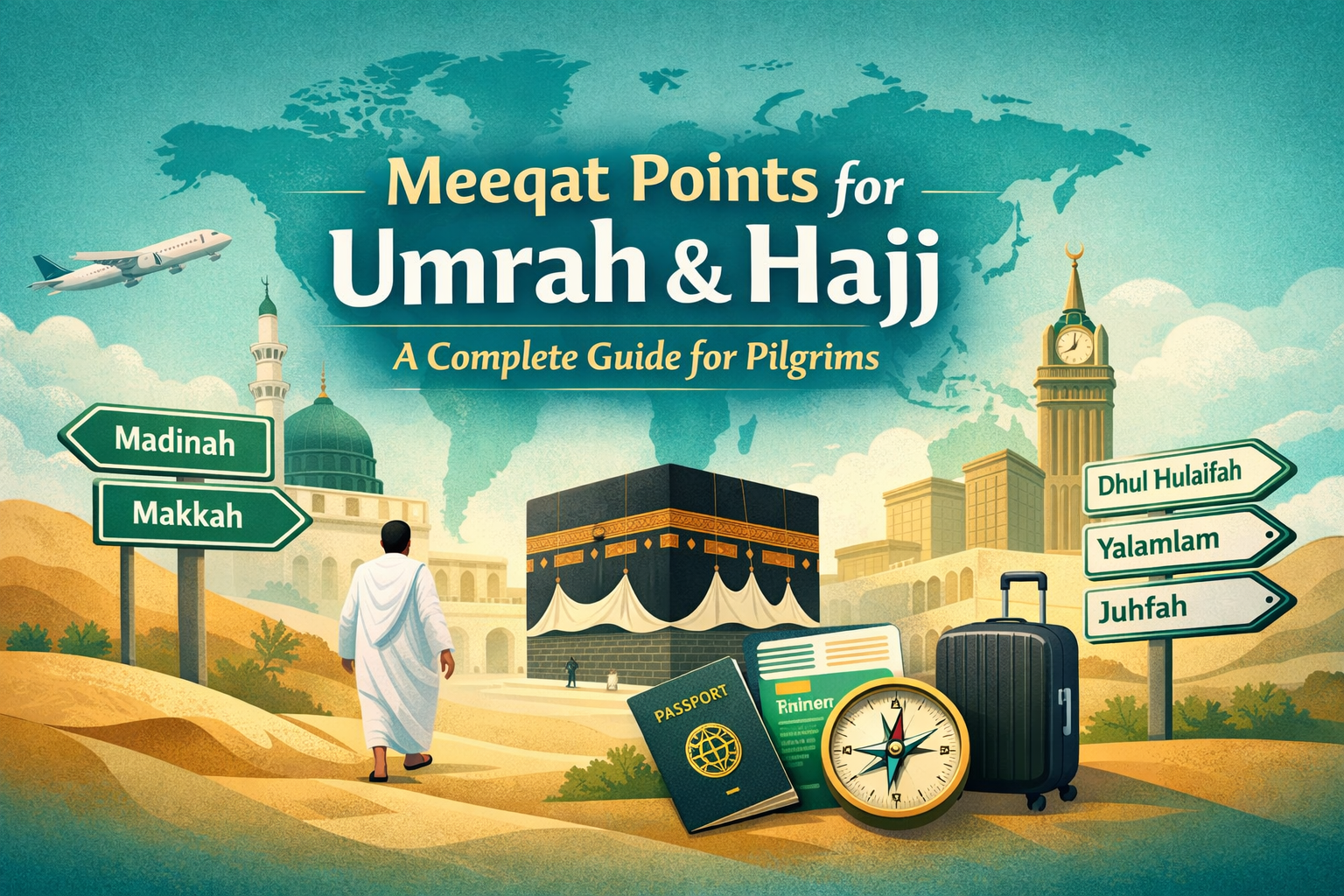
Performing Umrah or Hajj is one of the most spiritually rewarding journeys in a Muslim’s life. However, before entering the sacred state of Ihram, every pilgrim must pass through designated Meeqat points. Understanding these locations and their rules is essential to ensure your pilgrimage is valid and conducted in accordance with Islamic teachings.
In this comprehensive guide, we will explore Meeqat points in detail, their significance, locations, and practical tips to help pilgrims prepare for a smooth, spiritually fulfilling journey.
What Are Meeqat Points?
Meeqat points are specific geographical boundaries set by Islamic law where pilgrims intending to perform Hajj or Umrah must enter the state of Ihram. Ihram is a sacred state that involves wearing prescribed clothing and making the intention (niyyah) for pilgrimage.
These boundaries were defined by Prophet Muhammad (peace be upon him) to regulate the starting point of pilgrimage rituals. Crossing a Meeqat without entering Ihram is not permissible for those intending to perform Hajj or Umrah.
Importance of Meeqat in Islam
Meeqat points hold great significance in Islam because they mark the transition from ordinary life to a sacred spiritual state. Entering Ihram at Meeqat symbolises humility, equality, and devotion to Allah.
Regardless of a person’s background, wealth, or status, every pilgrim dresses similarly and follows the same rules. This unity reflects the essence of Islam and reminds believers of the Day of Judgment when all will stand equal before Allah.
The Five Main Meeqat Points
There are five primary Meeqat points designated for pilgrims travelling from different directions. Each Meeqat corresponds to a specific region.
1. Dhul Hulaifa (Abyar Ali)
This Meeqat is for pilgrims coming from Madinah. It is the farthest Meeqat from Makkah and is commonly used by those visiting Madinah before performing Umrah or Hajj.
2. Juhfah
This Meeqat is for pilgrims from regions such as Syria, Egypt, and parts of Africa. Today, many pilgrims use Rabigh, which is near Juhfah, as their Meeqat.
3. Qarn al-Manazil
This Meeqat is for pilgrims travelling from Najd and nearby regions, including those coming from the eastern side of Saudi Arabia.
4. Yalamlam
This Meeqat is designated for pilgrims coming from Yemen and the southern regions. Many travellers from countries like Pakistan, India, and Bangladesh may align with this Meeqat depending on their flight route.
5. Dhat Irq
This Meeqat is for pilgrims arriving from Iraq and nearby areas.
Meeqat Points for Air Travelers
Today, many pilgrims travel by air to Saudi Arabia. For such travelers, Meeqat rules still apply, but the approach is slightly different.
Pilgrims must enter the Ihram before crossing the Meeqat boundary during their flight. Airlines often announce when the plane is approaching Meeqat, giving passengers time to prepare.
It is recommended to:
- Wear Ihram clothing before boarding or during the flight.
- Make the intention (niyyah) before crossing Meeqat.
- Begin reciting Talbiyah after entering the Ihram.
Missing this step may require a penalty (Dam), so preparation is crucial.
Rules of Ihram at Meeqat
When reaching a Meeqat point, pilgrims must follow certain steps to enter Ihram properly:
- Perform Ghusl (purification) if possible.
- Wear Ihram garments (two white sheets for men; modest dress for women)
- Offer two rak’ahs of prayer (optional but recommended)
- Make the intention (niyyah) for Umrah or Hajj.
- Recite Talbiyah: “Labbayk Allahumma Labbayk…”
Once in Ihram, certain actions become prohibited, such as cutting hair, using perfume, or engaging in arguments.
Common Mistakes to Avoid at Meeqat
Many pilgrims, especially first-timers, make mistakes regarding Meeqat. Being aware of these can help you avoid unnecessary complications.
- Crossing Meeqat without Ihram
- Delaying intention until after Meeqat
- Not knowing the correct Meeqat for your route.
- Ignoring announcements during flights
- Improper Ihram clothing or preparation
Planning ahead and seeking guidance can prevent these errors.
Practical Tips for Pilgrims
Preparing for Meeqat is not just about rules, it’s also about mindset and readiness. Here are some practical tips:
- Research your route to know which Meeqat applies to you.
- Keep Ihram clothing easily accessible during travel.
- Stay spiritually focused and make dua before entering Ihram.
- Travel with experienced groups or guides if possible
- Listen carefully to airline instructions.
For many pilgrims, choosing reliable hajj and umrah packages can make this process much easier. These packages often include guidance on Meeqat, Ihram preparation, and overall pilgrimage planning, helping you focus on worship rather than logistics.
Spiritual Significance of Meeqat
Meeqat is not just a physical boundary, it is a spiritual turning point. As you cross this line, you leave behind worldly distractions and enter a state of complete submission to Allah.
It is a moment to purify your intentions, seek forgiveness, and prepare your heart for the sacred rituals ahead. Many pilgrims describe this transition as deeply emotional and transformative.
Conclusion
Understanding Meeqat points is essential for every Muslim planning to perform Umrah or Hajj. These sacred boundaries ensure that pilgrims begin their journey in the proper state of Ihram, following the Sunnah of Prophet Muhammad (peace be upon him).
By learning about the locations, rules, and significance of Meeqat, you can avoid common mistakes and focus on the spiritual essence of your pilgrimage. Whether travelling by land or air, preparation is key to a smooth and meaningful experience.
As you embark on this blessed journey, remember that Meeqat is the first step toward a life-changing spiritual experience, one that brings you closer to Allah and strengthens your faith forever.
Onais is an Arabic language specialist who completed his Bachelor’s in Arabic from the International Islamic University, Islamabad, and is currently pursuing his Master’s degree there. Having lived in the UAE for 17 years, he brings strong command of Middle Eastern Arabic dialects and focuses on practical, easy-to-understand Arabic language courses.