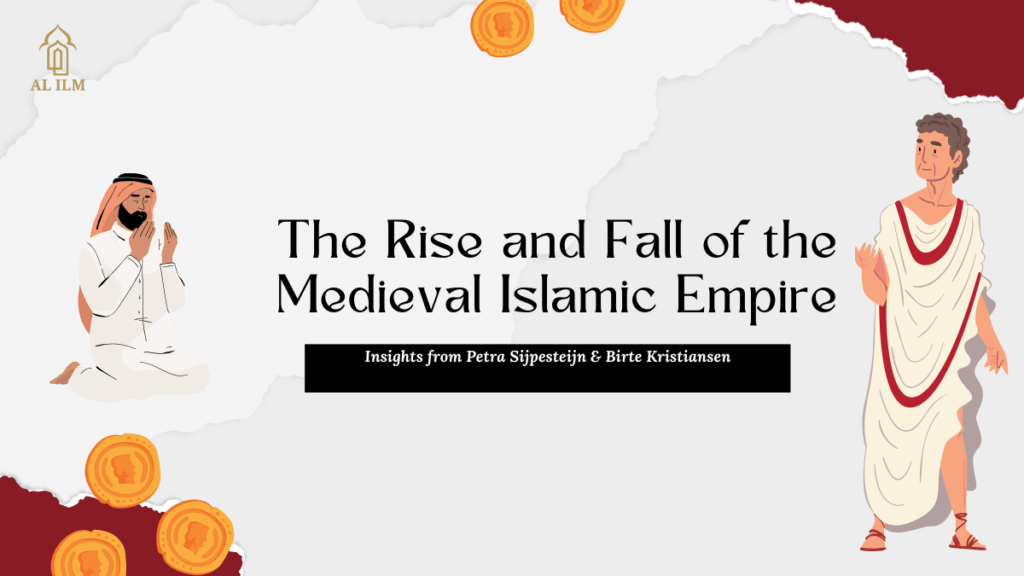
The medieval Islamic Empire stands as one of history’s most influential civilizations. It expanded rapidly across continents, became a global center of scholarship and commerce, and ultimately fragmented into diverse regional powers. Drawing on the work of historians such as Petra M. Sijpesteijn and Birte Kristiansen, this article explores how the empire rose to power, reached its intellectual zenith, and eventually declined as a unified political entity.
The Rise: Unification and Conquest
The empire’s origins lie in early 7th-century Arabia, where profound religious and political transformation began.
Unity Under Islam
The Prophet Muhammad صلى الله عليه وسلم united the Arabian tribes under Islam, establishing a shared legal, ethical, and social framework that transcended tribal divisions. This unity laid the groundwork for state formation and sustained political authority.
Rapid Territorial Expansion
After the Prophet’s صلى الله عليه وسلم death, the Rashidun Caliphs led an unprecedented expansion. Within decades, Muslim armies had defeated the Byzantine forces in the Levant and the Sasanian Empire in Persia — two long-standing global powers.
A Transcontinental Empire
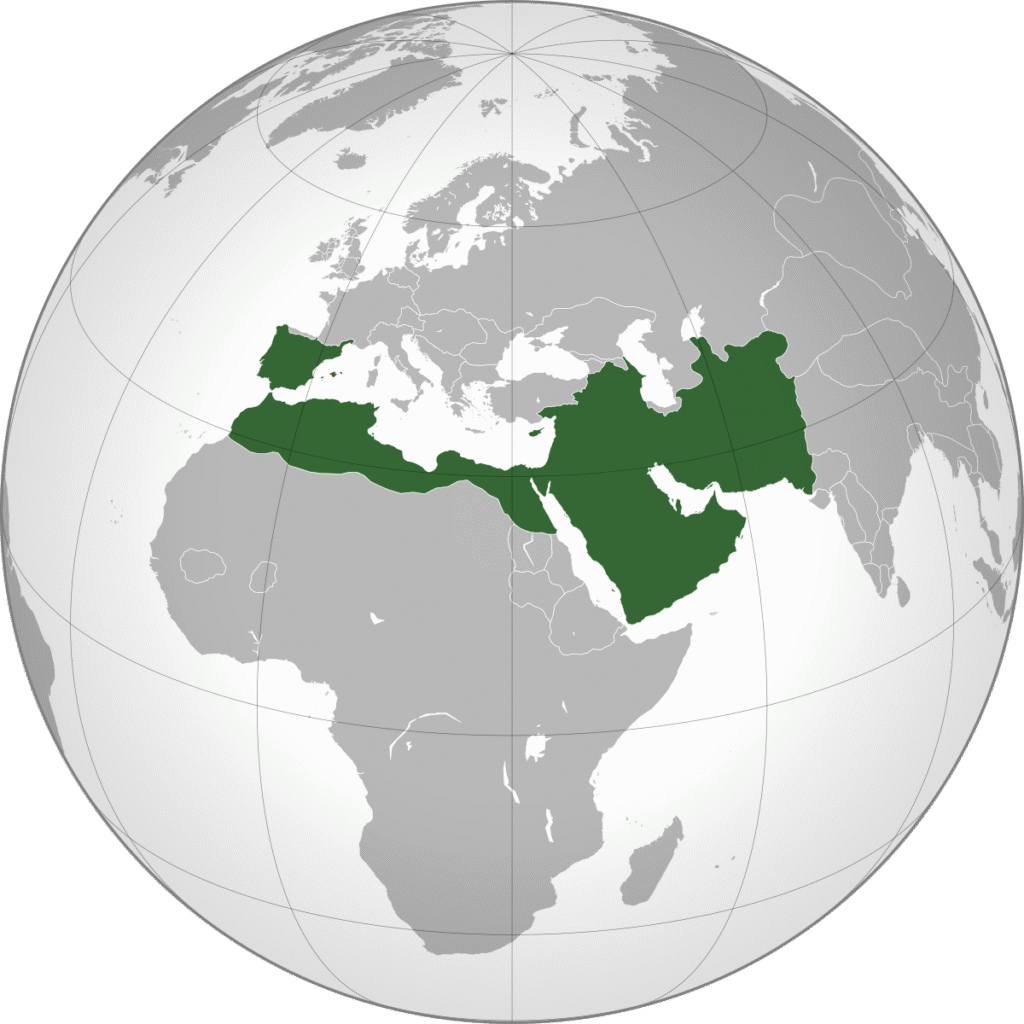
By the early 8th century, territories stretched from Al-Andalus (Spain) to the Indus Valley, forming one of the largest empires of its time. This expansion enabled new networks of culture, governance, and trade across Afro-Eurasia.
The Great Dynasties and the Golden Age
Two major dynasties defined the shape and achievements of the medieval Islamic world.
The Umayyad Caliphate (661–750 CE)
Capital: Damascus
The Umayyads consolidated conquered lands and built a strong administrative system. However, an Arab-centric power structure led to tensions with non-Arab Muslim converts (Mawālī), contributing to their downfall.
Sijpesteijn’s research highlights the role of military loyalty and discipline during this period as both a strength and future vulnerability for caliphal authority.¹
The Abbasid Caliphate (750–1258 CE)
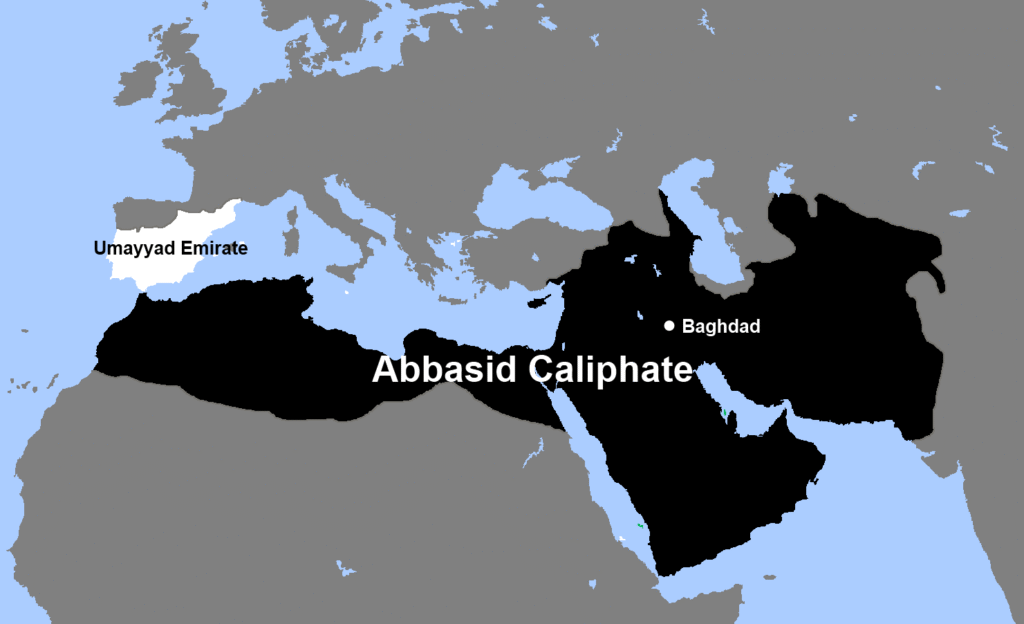
Capital: Baghdad
The Abbasids rose to power with significant Persian support and shifted toward a more inclusive, cosmopolitan empire. Persian cultural influence reshaped administration, literature, and court life.
The Islamic Golden Age
Under the Abbasids, Baghdad became the world’s preeminent center of science and learning:
- House of Wisdom: Scholars translated and advanced Greek, Roman, Persian, and Indian knowledge
- Achievements in Science: Innovations in medicine, astronomy, algebra, geography, and philosophy
- Global Trade: Exchanges across the Silk Road and Indian Ocean fueled prosperity and cultural integration
This scholarly output not only preserved classical knowledge but also laid foundations for future European scientific advancements.
Fragmentation and Decline: A Gradual Transformation
The fall of the empire was not a single event but a long period of decentralization, regional power shifts, and foreign invasions.
Internal Pressures
Sijpesteijn and Kristiansen highlight how social dependency, regional governance, and negotiation of loyalty shaped the empire’s internal cohesion.² ³
Over time, provincial governors gained autonomy as communication and administrative reach weakened.
New rival dynasties emerged:
- Umayyads in Al-Andalus
- Fatimids in Egypt
- Independent Persian and Central Asian states
The growing reliance on Turkish military elites further eroded the caliph’s authority, turning rulers into symbolic figureheads by the 11th century.
External Threats
- Crusades (11th–13th centuries): Intensified political fragmentation, though not the root cause
- Mongol Invasion (1258 CE): The decisive blow — Baghdad was sacked, the House of Wisdom destroyed, and the last Abbasid caliph killed
This moment marks the conventional end of the unified caliphate.
Legacy and Continued Influence
Despite political collapse, Islamic civilization’s legacy endured:
- Successor states — including the Mamluks, Ottomans, and Safavids — preserved Islamic authority and culture
- Islamic scholarship profoundly shaped later scientific development
- Islam spread across Africa, Central Asia, and Southeast Asia, becoming a major global civilization
As Kristiansen and others show, kinship, social identity, and shared religious institutions ensured continuity long after the fall of centralized power.⁴
Conclusion
The medieval Islamic Empire remains a remarkable example of how religious unity, administrative innovation, and cultural exchange can build — and sustain — vast global civilizations. By examining both the top-down power of the caliphs and the bottom-up social networks explored by scholars like Sijpesteijn and Kristiansen, we gain a more complete picture of how this empire not only rose and flourished — but also adapted and endured through transformation.
References
- Sijpesteijn, Petra M. “Closing Ranks: Discipline and Loyalty in the Umayyad Army.” Al-Ṯurayyā: The Journal of Arabic Astronomy and Mathematics, 2022.
- Hayes, Edmund & Sijpesteijn, Petra M. (eds.). Mechanisms of Social Dependency in the Early Islamic Empire. Cambridge University Press, 2024.
- Sijpesteijn, Petra M. Shaping a Muslim State: The World of a Mid-Eighth-Century Egyptian Official. Oxford University Press, 2013.
- Palombo, Cecilia & Kristiansen, Birte (eds.). “Ties of Kinship and Islamicate Societies.” Medieval Encounters, Vol. 29, Issues 5–6, 2023.
- Sijpesteijn, Petra & Kristiansen, Birte. “The Rise and Fall of the Medieval Islamic Empire.” TED-Ed Animation, 2022.
Onais is an Arabic language specialist who completed his Bachelor’s in Arabic from the International Islamic University, Islamabad, and is currently pursuing his Master’s degree there. Having lived in the UAE for 17 years, he brings strong command of Middle Eastern Arabic dialects and focuses on practical, easy-to-understand Arabic language courses.