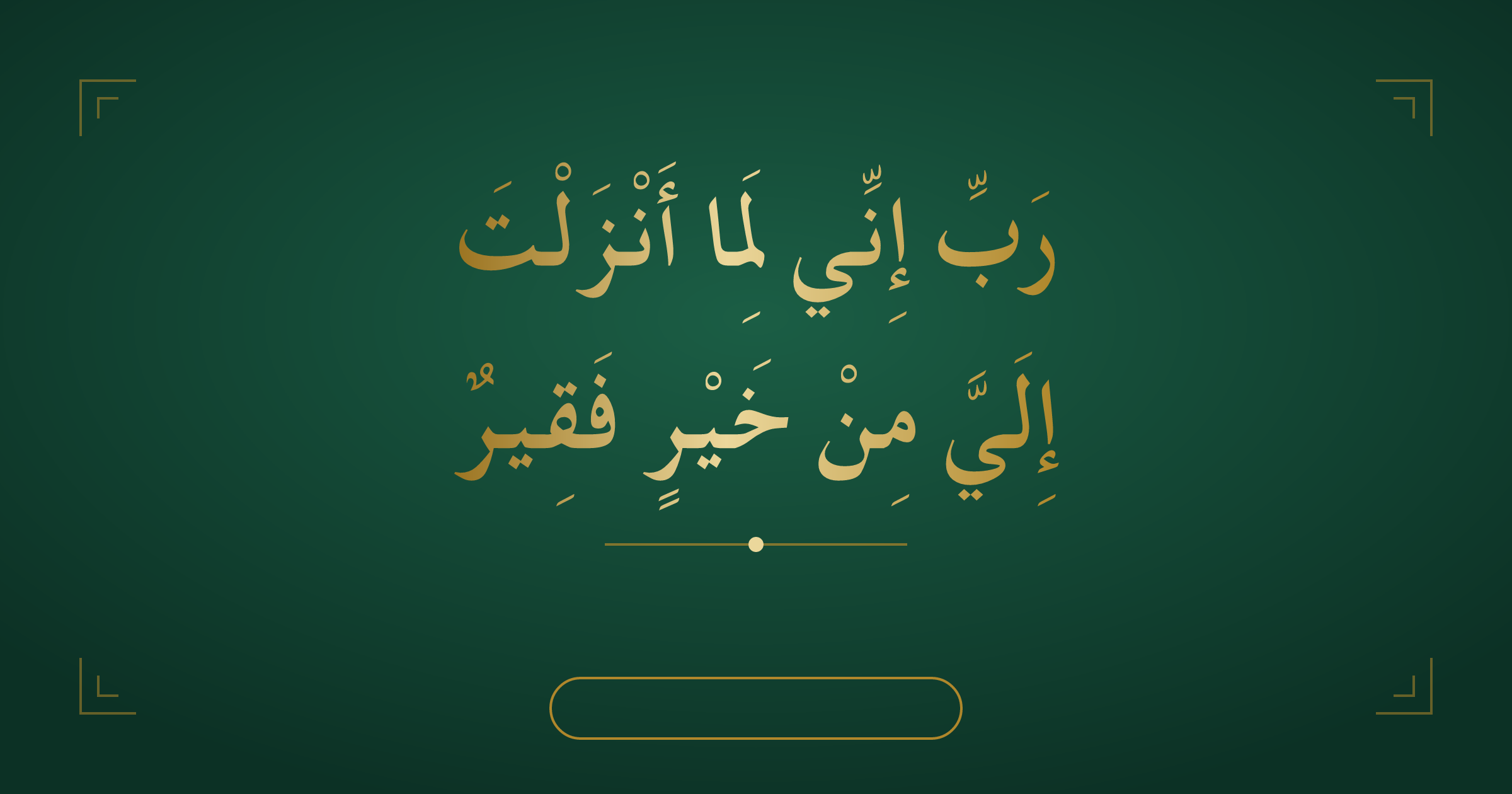
Rabbi Inni Lima Anzalta is one of the shortest and most moving supplications in the Qur’an. Prophet Musa (peace be upon him) said it at the lowest point of his life — hungry, homeless, hunted, and alone in a foreign land.
Eleven Arabic words. Within moments, Allah answered them with shelter, work, a wife, and a home.
This guide gives you the dua in Arabic, an easy transliteration, its meaning word by word, the story behind it, and an honest look at what is — and isn’t — authentically established about its benefits.
What Is the Dua Rabbi Inni Lima Anzalta?
It is a supplication from Surah al-Qasas, verse 24 — part of the Qur’an’s account of Musa (peace be upon him) fleeing Egypt and arriving in Madyan.
Because it comes from the Qur’an itself, this is a dua whose wording was chosen by Allah. That alone sets it apart from supplications people compose for themselves.
Rabbi Inni Lima Anzalta in Arabic
Here is the full verse, with the dua highlighted within it:
فَسَقَىٰ لَهُمَا ثُمَّ تَوَلَّىٰ إِلَى الظِّلِّ فَقَالَ رَبِّ إِنِّي لِمَا أَنْزَلْتَ إِلَيَّ مِنْ خَيْرٍ فَقِيرٌ
And the dua on its own — the part people memorise and repeat:
رَبِّ إِنِّي لِمَا أَنْزَلْتَ إِلَيَّ مِنْ خَيْرٍ فَقِيرٌ
Rabbi Inni Lima Anzalta Transliteration
Rabbi innī limā anzalta ilayya min khayrin faqīr.
The full verse: Fa-saqā lahumā thumma tawallā ila-ẓ-ẓilli fa-qāla Rabbi innī limā anzalta ilayya min khayrin faqīr.
Rabbi Inni Lima Anzalta Meaning in English
“My Lord, I am truly in need of whatever good You send down to me.”
The full verse reads: “So he watered ˹their herd˺ for them, then withdrew to the shade and prayed, ‘My Lord! I am truly in ˹desperate˺ need of whatever provision You may have in store for me.'” (Surah al-Qasas 28:24, translation by Dr. Mustafa Khattab)
Word-by-Word Meaning
| Arabic | Transliteration | Meaning |
|---|---|---|
| رَبِّ | Rabbi | My Lord — Rabb means the One who owns, sustains, nurtures and brings to completion |
| إِنِّي | innī | Indeed, I |
| لِمَا | limā | For whatever |
| أَنْزَلْتَ | anzalta | You send down |
| إِلَيَّ | ilayya | To me |
| مِنْ خَيْرٍ | min khayrin | Of good — khayr covers every kind of good, not only wealth |
| فَقِيرٌ | faqīr | Am in need, poor, utterly dependent |
Two words carry most of the weight. Khayr is deliberately open — it includes food, safety, health, knowledge, companionship, guidance and peace of mind. Faqīr is not “I could use some help”; it is the word for someone who owns nothing and depends entirely on another.
The Story Behind the Dua: Musa in Madyan
To feel the dua, you need the scene around it. The Qur’an tells it in Surah al-Qasas 28:20–28.
Musa (peace be upon him) had grown up in Pharaoh’s household, in what Ibn Kathir describes as a life of luxury and leadership. Then he struck an Egyptian who died, and a man came to warn him that the chiefs were plotting to kill him. He left Egypt alone and on foot — “looking about in a state of fear” (28:21) — crossing the desert toward Madyan with no food, no money, and no one expecting him.
At the well of Madyan he found shepherds crowding to water their flocks, and two women holding their sheep back. He asked what was wrong. They could not water until the shepherds finished, they said, and their father was a very old man.
Exhausted and starving as he was, Musa watered their flocks for them first. Only then did he withdraw to the shade — Ibn ‘Abbas, Ibn Mas’ud and As-Suddi say he sat beneath a tree — and made this dua.
The answer arrived almost immediately. In the very next verse, one of the two women came back to him, walking shyly, to say her father was inviting him. That invitation became employment, marriage into a righteous household, and a home for the next eight to ten years. Years later, returning from Madyan with his family, Musa would see a fire in the valley and be given prophethood.
He asked for “whatever good.” He was given a life.
Why This Dua Is So Powerful
Scholars have long drawn attention to what Musa (peace be upon him) didn’t say.
He served before he asked. He was the hungriest person at that well, and he still helped two strangers before turning to his own need.
He never named what he wanted. He did not say “give me food” or “give me shelter.” He simply described his own condition and left the choosing to Allah. This is one of the most refined forms of dua in the Qur’an — presenting your need rather than dictating the solution.
He asked for khayr, not for wealth. Plenty of things a person wants are not good for them. Asking for “whatever good You send down” filters the request through Allah’s knowledge rather than your own.
He admitted total dependence. A Prophet of Allah, raised in a palace, calling himself faqīr — from under a tree, with nothing. There is no version of you too capable to say that word honestly.
‘Ata’ ibn as-Sa’ib adds a human detail preserved in the tafsir: when Musa said these words, the two women heard him.
Benefits and Virtues of Rabbi Inni Lima Anzalta
What is authentically established about this dua is substantial:
- It is the speech of Allah. Reciting it is recitation of the Qur’an, which carries reward in itself.
- It is a Prophet’s own supplication, preserved for us to use — the Qur’an records the duas of the Prophets precisely so we can learn to ask the way they asked.
- It fits every hardship. Because khayr is unrestricted, the same eleven words work for provision, marriage, health, a job, guidance or peace of mind.
- It teaches the manners of asking — humility, patience and trust — and it is short enough to actually use: in the queue, in the car, in sujud, in the middle of a hard day.
About the “Recite It 100 Times” Claims
Search for this dua and you will find pages promising results if you recite it 24, 100, 300 or 564 times, for seven days or forty days, at a particular hour.
It is worth knowing where those numbers come from: not from the Qur’an, and not from any authentic hadith. No narration from the Prophet (peace be upon him) prescribes a count, a duration or a time for this particular verse.
Scholars have addressed this pattern directly. Fixing a specific number or time for a dhikr or supplication that the Sharia did not fix is generally treated as an innovation added to worship — not because the words are wrong, but because the restriction is invented. Islam Q&A discusses exactly this in fatwa 259482.
This is not a reason to recite the dua less. It is a reason to recite it freely — as often as you like, whenever you like, without the anxiety of a count, and without treating it as a formula that obliges Allah to respond in a particular way. Musa (peace be upon him) said it once.
If you have a specific personal situation, a qualified scholar or your local imam is the right person to ask.
When and How to Recite It
There is no fixed time, so use the times the Sunnah identifies as most hopeful for any dua:
- In sujud, the closest a servant is to their Lord
- In the last third of the night
- Between the adhan and the iqamah
- While fasting, and at the moment of breaking the fast
- During rain, while travelling, and in the hour of acceptance on Friday
A few things that help:
- Understand what you are saying — hold the meaning in your heart alongside the Arabic.
- Begin with praise of Allah and salawat upon the Prophet (peace be upon him), as the Sunnah teaches.
- Say it with certainty, be patient with the answer, and take the practical steps too. Musa made dua and he watered the flocks.
Common Mistakes to Avoid
- Treating it as a formula. A dua is a request to the Most Generous, not a code that unlocks a result.
- Reciting it while neglecting the means. Dua for rizq and a job application are not in competition.
- Assuming khayr means money. Narrowing the word narrows the dua.
- Giving up if the answer is slow. Musa’s answer was quick; Ya’qub (peace be upon him) waited years. Both were answered.
- Learning it only from transliteration. English letters cannot carry the throat letters accurately — and this dua is worth pronouncing properly.
Frequently Asked Questions
What does Rabbi Inni Lima Anzalta mean?
It means “My Lord, I am truly in need of whatever good You send down to me.” It is a statement of complete dependence on Allah, without specifying what is being asked for.
Where is Rabbi Inni Lima Anzalta in the Quran?
Surah al-Qasas, chapter 28, verse 24. It is part of the account of Prophet Musa (peace be upon him) arriving in Madyan after fleeing Egypt.
Is Rabbi Inni Lima Anzalta a dua for rizq?
It is often used that way, and appropriately so — Musa said it in a state of hunger and poverty. But the word he used is khayr (good), not māl (wealth), so the dua covers far more than provision: safety, guidance, companionship, health and peace of mind all fall under it.
Is it a dua for marriage?
Many people recite it hoping for marriage, drawing on the fact that Allah answered Musa with a righteous spouse. That is a reasonable hope, but the verse itself does not name marriage — it asks for good in general and leaves the form of that good to Allah.
How many times should I recite Rabbi Inni Lima Anzalta?
There is no number prescribed in the Qur’an or authentic Sunnah. Recite it as often as you wish. The specific counts circulated online have no established basis.
Can I recite Rabbi Inni Lima Anzalta in English?
You can and should understand it in English, and there is nothing wrong with making dua in your own language. But this dua is a verse of the Qur’an, so recite the Arabic itself — the reward of Qur’an recitation attaches to the Arabic words.
Is Rabbi Inni Lima Anzalta the same as Kun Fayakun?
No. Kun fayakūn (“Be — and it is”) is from Surah Ya-Sin 36:82 and describes Allah’s power to create by command. The two are often paired in social media graphics, but they are separate verses from separate surahs.
Learn to Recite It the Way It Was Revealed
Eleven words — but faqīr, khayr and the doubled yy of ilayya all depend on sounds English simply doesn’t have. A verse of the Qur’an deserves to be said correctly.
Al-Ilm Academy offers one-to-one online Quran and Tajweed classes with qualified male and female teachers, at times that fit around work and school. Your first class is free.
👉 Book your free trial Quran class at Al-Ilm Academy and learn to recite Rabbi Inni Lima Anzalta — and the rest of Surah al-Qasas — with confidence, in shā’ Allah.
Want to Master Quran Recitation & Tajweed Live?
Join Al-Ilm Academy today and learn 1-on-1 with Ijazah-certified male and female tutors tailored to your schedule.
Reviewed by Al-Ilm Academic Panel
Onais Khan & Certified Senior Scholars
This guide was produced and reviewed by certified Quran reciters and Arabic linguists at Al-Ilm Academy to ensure authentic Islamic guidance.
📚 Recent Articles
-
How to Find the Best Cheap Umrah Packages in 2026 Sep 16, 2026