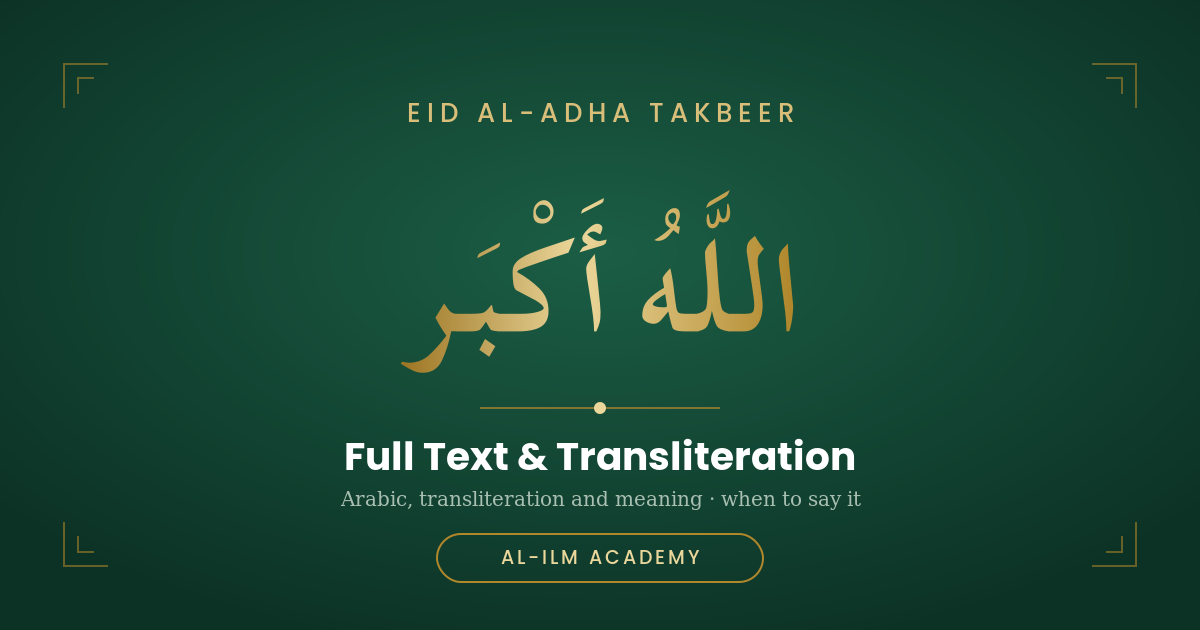
The Eid al-Adha takbeer is the declaration that fills the streets, homes and masjids from the first of Dhul-Hijjah through the days of Tashreeq: Allāhu akbar, Allāhu akbar, lā ilāha illā-Llāh…
Here is something most articles will not tell you. The Prophet (peace be upon him) did not specify a fixed wording for it. Several different formulas are authentically narrated from the Companions, and the scholars of all four schools treated the matter as broad. If your family’s version differs from your masjid’s, neither of you is necessarily wrong.
This guide gives you the main authentic wordings in Arabic with transliteration and meaning, explains exactly when each type of takbeer is said, and shows where each formula comes from.
Quick Answer
- The takbeer’s wording is not fixed by the Prophet (peace be upon him). The command in the Qur’an is to magnify Allah in general; no authentic marfu’ hadith prescribes a set formula.
- The most widely used wording comes from Ibn Mas’ud (may Allah be pleased with him): Allāhu akbar, Allāhu akbar, lā ilāha illā-Llāh, wa-Llāhu akbar, Allāhu akbar, wa li-Llāhi-l-ḥamd.
- Ibn Hajar considered the strongest chain to be that of Salman (may Allah be pleased with him): Allāhu akbar, Allāhu akbar, Allāhu akbaru kabīrā.
- Two kinds of takbeer: mutlaq (unrestricted — any time from 1 Dhul-Hijjah through the days of Tashreeq) and muqayyad (restricted — after the obligatory prayers, from Fajr on the Day of Arafah to Asr on the 13th).
- Saying it aloud, individually rather than in chorus, is the practice reported from the Companions.
Why the Takbeer Is Said
The Qur’an ties this dhikr directly to the sacrifice of Eid al-Adha:
لَن يَنَالَ اللَّهَ لُحُومُهَا وَلَا دِمَاؤُهَا وَلَكِن يَنَالُهُ التَّقْوَى مِنكُمْ كَذَلِكَ سَخَّرَهَا لَكُمْ لِتُكَبِّرُوا اللَّهَ عَلَى مَا هَدَاكُمْ
“Neither their meat nor blood reaches Allah. Rather, it is your piety that reaches Him. This is how He has subjected them to you so that you may proclaim the greatness of Allah for what He has guided you to.” — Surah al-Hajj 22:37
And of the days that follow Eid:
وَاذْكُرُوا اللَّهَ فِي أَيَّامٍ مَّعْدُودَاتٍ
“And remember Allah during ˹these˺ appointed days.” — Surah al-Baqarah 2:203
Note what the verse commands: proclaim His greatness — not “recite the following words.” The instruction is general, which is exactly why the scholars allowed breadth in how it is worded.
Eid al-Adha Takbeer: Full Text
The Most Common Wording (from Ibn Mas’ud)
اللَّهُ أَكْبَرُ، اللَّهُ أَكْبَرُ، لَا إِلَهَ إِلَّا اللَّهُ، وَاللَّهُ أَكْبَرُ، اللَّهُ أَكْبَرُ، وَلِلَّهِ الْحَمْدُ
Transliteration:
Allāhu akbar, Allāhu akbar, lā ilāha illā-Llāh, wa-Llāhu akbar, Allāhu akbar, wa li-Llāhi-l-ḥamd.
Meaning:
“Allah is the Greatest, Allah is the Greatest. There is no god but Allah. Allah is the Greatest, Allah is the Greatest, and to Allah belongs all praise.”
Source: Reported from Ibn Mas’ud (may Allah be pleased with him) and others of the early generations in al-Musannaf of Ibn Abi Shaybah (2/165–168); see al-Albani, Irwa al-Ghalil 3/125. Both the two-fold and three-fold opening are reported — that is, beginning with Allāhu akbar twice or three times. Either is fine.
Line by line
| Arabic | Transliteration | Meaning |
|---|---|---|
| اللَّهُ أَكْبَرُ | Allāhu akbar | Allah is the Greatest |
| لَا إِلَهَ إِلَّا اللَّهُ | lā ilāha illā-Llāh | There is no god but Allah |
| وَاللَّهُ أَكْبَرُ | wa-Llāhu akbar | And Allah is the Greatest |
| وَلِلَّهِ الْحَمْدُ | wa li-Llāhi-l-ḥamd | And to Allah belongs all praise |
The Wording with the Strongest Chain (from Salman)
Ibn Hajar wrote in Fath al-Bari (2/462) that the most authentic narration on the format of the Eid takbeer is the one recorded by ‘Abd ar-Razzaq with a sahih chain from Salman (may Allah be pleased with him):
اللَّهُ أَكْبَرُ، اللَّهُ أَكْبَرُ، اللَّهُ أَكْبَرُ كَبِيرًا
Allāhu akbar, Allāhu akbar, Allāhu akbaru kabīrā.
“Allah is the Greatest, Allah is the Greatest, Allah is the Greatest — greatness beyond measure.”
Short, and the best-attested of them all.
The Wording from Ibn Abbas
اللَّهُ أَكْبَرُ، اللَّهُ أَكْبَرُ، اللَّهُ أَكْبَرُ وَلِلَّهِ الْحَمْدُ، اللَّهُ أَكْبَرُ وَأَجَلُّ، اللَّهُ أَكْبَرُ عَلَى مَا هَدَانَا
Allāhu akbar, Allāhu akbar, Allāhu akbar wa li-Llāhi-l-ḥamd, Allāhu akbar wa ajall, Allāhu akbar ‘alā mā hadānā.
“Allah is the Greatest, Allah is the Greatest, Allah is the Greatest and to Allah belongs all praise. Allah is the Greatest and Most Majestic. Allah is the Greatest for having guided us.”
Source: Narrated by al-Bayhaqi (3/315) from Ibn Abbas (may Allah be pleased with him); classed as sahih by al-Albani in Irwa al-Ghalil 3/126.
The Longer Addition
Many communities add a longer passage after the takbeer, beginning Allāhu akbaru kabīrā wa-l-ḥamdu li-Llāhi kathīrā wa subḥāna-Llāhi bukratan wa aṣīlā… and continuing with lā ilāha illā-Llāhu waḥdah, ṣadaqa wa’dah, wa naṣara ‘abdah…
This is not baseless. Imam ash-Shafi’i recorded it in al-Umm (1/241) and said that whoever adds it “has done well.” Abu Ishaq ash-Shirazi noted in al-Muhadhdhab (1/121) that the Prophet (peace be upon him) said these words atop as-Safa.
Which Wording Should You Use?
Any of them. This is not a case where one version is correct and the rest are errors.
The classical scholars were explicit about this:
- Imam Malik — when Ibn al-Qasim was asked whether Malik specified a particular takbeer, he said no; Malik “did not say anything specific concerning these matters” (al-Mudawwanah 1/245).
- Imam Ahmad — “It is broad in scope.”
- Ibn al-Arabi — his school favoured the view that the takbeer is general, “which is the apparent meaning of the Qur’an.”
- As-San’ani — many formats are narrated from a number of imams, which itself shows the matter is broad (Subul as-Salam 2/72).
The one piece of guidance worth following: stick to what is narrated from the Companions rather than composing your own. Beyond that, use whichever wording your family or community uses, and do not argue about it on Eid.
When to Say the Eid al-Adha Takbeer
There are two distinct types, and confusing them is the most common mistake.
Takbeer Mutlaq — unrestricted
Said at any time, not tied to the prayers: walking, driving, cooking, in the market, at home.
- Begins: with the sighting of the new moon of Dhul-Hijjah (1 Dhul-Hijjah)
- Ends: at the close of the days of Tashreeq (sunset on 13 Dhul-Hijjah)
This is the takbeer of the whole ten days — the one Ibn Umar and Abu Hurayrah (may Allah be pleased with them) were known to say aloud in the marketplace, so that people would say it with them.
Takbeer Muqayyad — restricted
Said immediately after each of the five obligatory prayers.
- Begins: after Fajr on the Day of Arafah (9 Dhul-Hijjah) for those not performing Hajj
- Ends: after Asr on the last day of Tashreeq (13 Dhul-Hijjah)
That comes to twenty-three prayers in total. Pilgrims performing Hajj begin theirs after Dhuhr on the Day of Sacrifice (10 Dhul-Hijjah), because until then they are occupied with the talbiyah.
A note on the schools. The exact start and end points of the muqayyad takbeer differ somewhat between the madhhabs. The timing above is the one most widely followed. If your masjid begins or ends at a slightly different point, follow your local scholars — this is a known area of valid difference, not an error.
At a glance
| Takbeer Mutlaq | Takbeer Muqayyad | |
|---|---|---|
| When | Any time, day or night | After the five obligatory prayers |
| Starts | 1 Dhul-Hijjah | Fajr, 9 Dhul-Hijjah (Day of Arafah) |
| Ends | Sunset, 13 Dhul-Hijjah | Asr, 13 Dhul-Hijjah |
| Who | Everyone | Everyone not on Hajj (pilgrims start Dhuhr on the 10th) |
How to Say It
- Aloud, for men, in the masjid, at home, on the way to the Eid prayer and in the marketplace. Women say it quietly.
- Individually, not in chorus. The practice reported from the Companions is each person saying it themselves — which is why Ibn Umar’s takbeer in the market caused others to say it too, rather than everyone reciting in unison. Group recitation in one voice is a later practice, and some scholars have objected to it.
- On the way to the Eid prayer, continuing until the imam arrives.
- After the obligatory prayers during the muqayyad period, said directly after the salam and before the usual adhkar.
- No fixed number. Say it as much as you wish.
Common Mistakes to Avoid
- Believing there is one “correct” takbeer and that other wordings are wrong. Several are authentically narrated.
- Confusing mutlaq with muqayyad, and so stopping the takbeer after Eid prayer. The days of Tashreeq are still days of takbeer.
- Forgetting it after the prayers on the days of Tashreeq — the most commonly missed part.
- Playing recordings instead of saying it. The takbeer is an act of worship you perform, not audio you broadcast.
- Arguing about wordings on Eid. The scholars left this open; there is no benefit in closing it.
- Learning it from transliteration alone. Akbar and akbaru, ḥamd and hamd — the differences matter, and only a teacher will correct them.
Frequently Asked Questions
What is the full Eid al-Adha takbeer?
The most widely used wording is: Allāhu akbar, Allāhu akbar, lā ilāha illā-Llāh, wa-Llāhu akbar, Allāhu akbar, wa li-Llāhi-l-ḥamd — “Allah is the Greatest, Allah is the Greatest. There is no god but Allah. Allah is the Greatest, Allah is the Greatest, and to Allah belongs all praise.” It is reported from Ibn Mas’ud (may Allah be pleased with him).
Is the wording of the takbeer fixed by the Prophet?
No. No authentic hadith from the Prophet (peace be upon him) prescribes a particular formula. The Qur’anic command is to magnify Allah in general, and several wordings are authentically narrated from the Companions. Imam Ahmad described the matter as “broad in scope.”
When does the Eid al-Adha takbeer start?
The unrestricted (mutlaq) takbeer starts on 1 Dhul-Hijjah and may be said any time. The restricted (muqayyad) takbeer, said after the obligatory prayers, starts after Fajr on the Day of Arafah (9 Dhul-Hijjah) for those not on Hajj.
When does the Eid al-Adha takbeer end?
Both end with the days of Tashreeq — the muqayyad after Asr on 13 Dhul-Hijjah, and the mutlaq at sunset on the same day.
How many times should I say the takbeer?
There is no fixed number. Say it as often as you are able throughout the ten days and the days of Tashreeq.
Is Takbeer e Tashreeq the same thing?
Yes — takbeer at-tashreeq is the name commonly given to the takbeer said after the obligatory prayers during the days of Tashreeq, which is the muqayyad takbeer described above.
Should the takbeer be said in unison?
The practice narrated from the Companions is that each person says it individually and aloud, not in chorus. Group recitation in one voice is a later development and some scholars have objected to it. Follow the guidance of your local scholars.
Do women say the takbeer aloud?
Women say the takbeer, but quietly rather than raising the voice, particularly where non-mahram men are present.
Say It the Way It Was Meant to Be Said
The takbeer is short, which makes its pronunciation easy to get slightly wrong — and the differences are not cosmetic. Allāhu akbar is not Allāhu akbaar; the ḥ of ḥamd is not an English h.
Al-Ilm Academy offers one-to-one online Quran and Tajweed classes with qualified male and female teachers, at times that fit around work and school. Your first class is free.
👉 Book your free trial Quran class at Al-Ilm Academy and go into Dhul-Hijjah reciting with confidence, in shā’ Allah.
Want to Master Quran Recitation & Tajweed Live?
Join Al-Ilm Academy today and learn 1-on-1 with Ijazah-certified male and female tutors tailored to your schedule.
Reviewed by Al-Ilm Academic Panel
Onais Khan & Certified Senior Scholars
This guide was produced and reviewed by certified Quran reciters and Arabic linguists at Al-Ilm Academy to ensure authentic Islamic guidance.
📚 Recent Articles
-
How to Find the Best Cheap Umrah Packages in 2026 Sep 16, 2026