Most masjids do not have a software problem. They have a retyping problem.
The jamaat times change. Someone updates the hall screen. Someone else updates the website. A third person edits the WhatsApp group. The printed timetable by the door still says last month’s Asr. By Ramadan there are five sources of truth and at least two of them are wrong.
That is the actual failure mode in masjid administration, and it is worth naming precisely because most software marketed at mosques does not solve it. It adds a sixth place to type things.
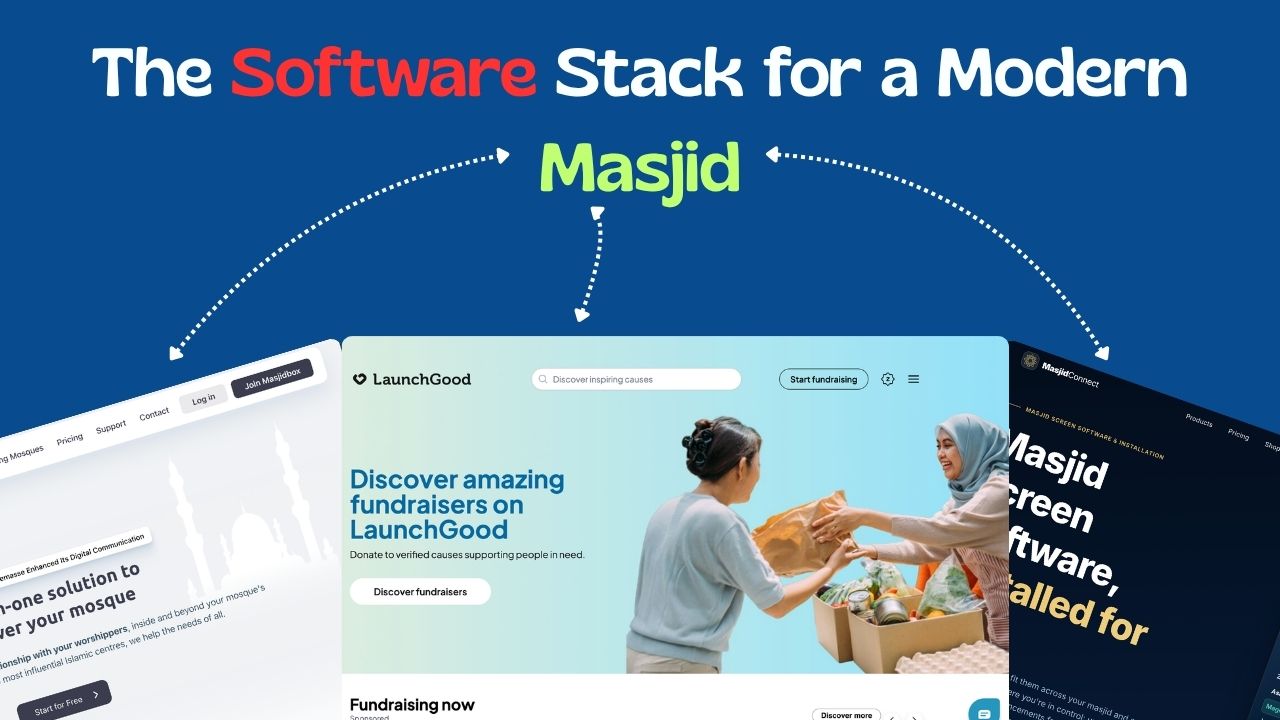
This guide covers what a masjid genuinely needs, layer by layer, with verified platforms and real pricing. It also covers something more important than any product recommendation: the reason masjid software projects fail, which has nothing to do with the software.
Quick Answer
- Start with prayer times and displays. This is the layer that touches everyone daily, and it is where the retyping problem lives. Fix it first.
- Free tiers are genuinely usable. Masjidbox offers free screens, apps, pages and donations; MasjidConnect offers a free forever tier with one screen.
- LaunchGood charges 0% platform fee on fundraising — you pay only card processing, about 2.9% + $0.30.
- Beware fabricated products. Several “top 10 masjid software” listicles rank platforms that do not appear to exist. See the warning below.
- Buy for your committee, not your features list. The most common cause of failure is that the one volunteer who understood the system left, and nobody else had the password.
- Donor data is an amānah. Choose vendors on their data handling, not only their price.
First, a Warning About “Top 10 Masjid Software” Lists
While researching this article I checked every product named in the major “best masjid management software 2026” listicles. Several of the most confidently described platforms — complete with feature lists, and in one case a full pricing table of $49 / $99 / $199 per month — have no official website, no app store presence, and no customer anywhere.
They appear only on a cluster of automated content farms that cite each other.
The pattern is not confined to masjid software. In AI tooling, widely-shared articles routinely quote benchmark scores that do not match the leaderboards they claim to cite — figures drift as they are copied between blogs until the number in circulation is nobody’s measurement. The defence is the same in both cases: open the primary source yourself.
This is worth pausing on. A masjid treasurer searching for software will hit those pages first. The descriptions are fluent, specific and completely unfounded — the AI hallucination problem applied to purchasing decisions.
Practical rule: if you cannot find the vendor’s own website, their pricing page, and at least one named masjid using them, the product does not exist. Applied to any software category, that rule is just checking claims against primary sources rather than secondary write-ups — slower to write, and the only version worth trusting.Every platform named in this article was verified by loading the vendor’s own site.
The Stack, Layer by Layer
Layer 1 — Prayer times and displays
This is the foundation, and the only layer where a bad choice is felt daily. What matters:
- One entry, every channel. Jamaat times entered once should flow to screens, website, app and printed calendar. If they do not, you have bought a display, not a system.
- Offline resilience. Masjid Wi-Fi is unreliable. A screen that goes blank on Friday because the router rebooted is worse than a whiteboard.
- Seasonal patterns and Jumu’ah handling. Multiple Jumu’ah slots and seasonal jamaat rules are where cheap tools break.
- Ramadan mode. Sehri and iftar timings, and a schedule that changes nightly.
Verified options: Masjidbox Screens (free tier; Silver €29/month), MasjidConnect (free tier; one-off licences £349–£999), Masjidal (Al-Iqamah displays, free service with a paid professional tier), ConnectMazjid.
Layer 2 — Donations and fundraising
The layer with the most money at stake and the widest spread in cost.
Two different needs get confused here:
Campaign fundraising — a roof appeal, a building fund, Ramadan. You want a platform built for campaigns, social sharing and matching.
Recurring giving — standing monthly donations, the boring revenue that actually keeps the lights on. You want low friction, card updating and good donor records.
Verified options: LaunchGood (0% platform fee, ~2.9% + $0.30 card processing; donors are prompted to tip, and LaunchGood states over 70% do), Masjidbox Donations (free), Givelify, Donorbox, and the built-in donation tools in most management platforms.
Watch the platform fee stacked on top of processing. MasjidConnect, for instance, charges 3.5% on its free tier falling to 1% on Pro, plus Stripe’s rate. On £100,000 of annual giving the difference between 3.5% and 1% is £2,500 a year — considerably more than the software licence.
Layer 3 — Membership and donor CRM
Most masjids run this on a spreadsheet that one person owns. It works until it does not.
What you actually need: a member record, contact details, membership status and renewal date, giving history, and Gift Aid declarations if you are a UK charity. Gift Aid alone justifies the layer — reclaiming 25% on eligible donations is usually worth more than every other efficiency combined.
This is normally a paid feature. On MasjidConnect it starts at the Growth tier (£499 one-off); MOHID, DeenConnect and Masjid Solutions all include membership management in their platforms.
Layer 4 — Events, classes and room bookings
Janazah arrangements, nikah bookings, hall hire, Ramadan programmes, weekend school registration. The requirement is unglamorous: a calendar that prevents double-booking and a registration form that does not require a volunteer to transcribe replies from WhatsApp.
If your masjid rents its hall, room booking with payment moves from convenience to revenue protection.
Layer 5 — Madrasah and weekend school
Genuinely distinct from masjid management, and the layer most often bodged. You need enrolment, class lists, attendance, fee collection, progress reporting and parent communication.
Two viable routes:
- A masjid platform with a school module — simpler, one vendor, usually less capable.
- A dedicated school system — more capable, another system to administer.
If your madrasah has more than about 100 students, the dedicated route usually wins. Below that, the integrated module is normally enough.
Layer 6 — Website
The masjid website has one job on the day it matters: someone’s relative has died and they need to know who to call. Prayer times, contact number, janazah information, and directions. Everything else is secondary.
Most platforms now offer website widgets or hosted pages that pull live prayer times, which solves the staleness problem at its root. Masjidbox Pages is free with a Silver tier at €15/month; MasjidConnect includes embeddable widgets on every tier.
Layer 7 — Communications
The default is a WhatsApp group, and the default is failing. Muted groups mean janazah announcements are missed.
Push notifications through a masjid app reach the lock screen. Both Masjidbox and MasjidConnect offer app listings — the latter at £129/year as an add-on. SMS remains the most reliable channel for genuinely urgent messages and the only one that reaches elders who are not on smartphones.
Layer 8 — Accounting
Do not run masjid finances inside your masjid platform. Use real accounting software — Xero, QuickBooks, or a charity-specific package — and integrate donations into it.
Trustees have legal reporting obligations. A donation module is not a general ledger, and no charity regulator will accept “it’s in the masjid app” as an audit trail.
Verified Platforms at a Glance
Pricing checked August 2026 against each vendor’s own pricing page. Always confirm before purchasing.
| Platform | Region focus | Model | Entry price | Notable |
|---|---|---|---|---|
| Masjidbox | Europe / global | Monthly subscription | Free tier; €29/mo screens, €15/mo pages, €62/mo all-in | Donations, widgets, calendars and social posting are free |
| MasjidConnect | UK | One-off licence | Free tier; £349 / £499 / £999 one-off | Lifetime licence rather than subscription; on-site installation from £899 |
| LaunchGood | Global | Per-donation | 0% platform fee | Card processing ~2.9% + $0.30; donor tipping model |
| MOHID | USA | Subscription | Quoted per masjid | Long-established US masjid CRM |
| Masjidal | USA / global | Freemium | Free service; paid pro tier | Athan+ app is free with no ads or in-app purchases |
| ConnectMazjid | Global | Subscription | Quoted | States 600+ masajid |
| Masjid Solutions | Global | Subscription | Quoted | Masjid and Islamic school management |
| Salah Mate | Global | Free | Free | Advertises itself as fully free — verify sustainability |
A note on the comparison tables published by vendors. MasjidConnect’s pricing page includes a table comparing itself against MOHID, MasjidBox, Masjidal and ConnectMazjid. It is useful for confirming those competitors exist, but the figures are one vendor’s characterisation of another’s pricing. Check each vendor directly.
The Donation Fee Question
There is a specifically Islamic dimension here that most buying guides skip.
When a platform takes a percentage of a donation, that percentage comes out of money donors intended for the masjid. For general ṣadaqah this is straightforwardly a service cost, and paying for a service is unremarkable.
Zakat is different. Zakat is an obligation owed to specific categories of recipient, and there is a real question about whether an administrative fee may be deducted from it, and if so on what basis. Classical fiqh discusses the ʿāmilīn ʿalayhā — those employed to collect zakat — as one of the eight categories, which is the door through which collection costs enter. But how that applies to a modern payment processor’s percentage is not something a software buying guide should rule on.
Two practical steps that sidestep most of the difficulty:
- Enable donor fee coverage. Most platforms let the donor add the fee at checkout so the full intended amount reaches the masjid. Masjidbox, MasjidConnect and LaunchGood all support this, and uptake is typically high.
- Route zakat separately. Keep zakat collection on a channel with the lowest possible deduction — often bank transfer or ACH, where fees are flat rather than percentage-based. LaunchGood’s ACH rate is a flat $0.30 regardless of amount.
If your masjid collects significant zakat, ask a qualified scholar how your committee should handle platform fees on it. This is a fiqh question, not a procurement question.
Donor Data Is an Amānah
Your donor database contains giving amounts, home addresses, family details and — in the case of zakat recipients — information about people’s poverty. That is among the most sensitive data any community organisation holds.
Islamic law treats information held on another’s behalf as an amānah, a trust that remains theirs and must not be betrayed. We covered the framework in detail in Data Privacy in Islam, but the procurement consequences are concrete:
- Ask where data is hosted and under which jurisdiction. MasjidConnect advertises UK hosting; others vary.
- Ask what happens when you leave. Can you export everything? Is it deleted?
- Never publish who gave what. Public donation leaderboards expose both the generous and, by absence, the struggling.
- Restrict admin access by role. The volunteer managing the display screen does not need the donor database.
- Zakat recipient records need the tightest handling of anything you hold. Concealing what you know of another’s hardship is a duty, not a courtesy.
How to Actually Choose
Feature comparison is the least useful part of this decision. Work through these instead.
1. Who will administer it in three years? Committees turn over. The best system is the one your least technical committee member can operate. If it needs the one brother who set it up, you have bought a dependency, not a solution.
2. Does it solve the retyping problem? Enter jamaat times once. If they do not propagate to every channel automatically, keep looking.
3. Subscription or one-off? A £499 one-off licence beats £46/month at around eleven months. But subscriptions include ongoing development, and a one-off licence from a vendor who goes quiet is worth nothing. Judge the vendor, not just the arithmetic.
4. Can you leave? Export your members, donors and giving history before you commit — not after you want out. If there is no export, that is your answer.
5. Have you spoken to a masjid using it? Ask the vendor for a reference in your country and phone them. Ten minutes with a real committee beats any feature matrix.
6. Start free and prove it. Both Masjidbox and MasjidConnect have genuine free tiers. Run one screen for a month before spending anything.
Realistic Budgets
| Masjid size | Sensible stack | Approximate annual cost |
|---|---|---|
| Small (one hall, volunteer-run) | Free tier display + free donations + basic website widget | £0 plus card processing |
| Medium (multiple screens, madrasah, membership) | Paid display tier + membership CRM + donation platform + school module | £350–£700/year, or a one-off licence |
| Large (multi-site, staff, significant giving) | Full platform + dedicated school system + proper accounting + support plan | £1,500–£3,000/year including support |
Against a typical masjid’s utility bill, even the top tier is modest. The binding constraint is almost never money — it is whether anyone has time to run it.
What to Avoid
- Buying during Ramadan. You will not have time to configure it, and it will be judged at your busiest moment. Buy in Shawwal.
- Ten screens before one works. Get a single display right, then scale.
- Custom-built by a volunteer. It works beautifully until they move city, and then nobody can change the Jumu’ah time.
- Any product you cannot find a website for. See the warning above.
- Interest-bearing business accounts attached to your donation flow. Ask your bank directly.
- Committing before export is tested. Data you cannot get out is data you do not own.
- One person holding every password. Use a shared credential vault and make sure at least two trustees have access. This is the single most common cause of masjid software collapse, and it costs nothing to prevent.
Frequently Asked Questions
What is the best masjid management software? There is no single best. Masjidbox is strong in Europe with a genuinely capable free tier; MasjidConnect suits UK masjids preferring a one-off licence over a subscription; MOHID is long-established in the US. Choose on administrability by your committee, not feature count.
Is there free mosque management software? Yes, and the free tiers are usable rather than token. Masjidbox provides free screens, applications, pages, donations, widgets and calendars. MasjidConnect offers a free forever plan with one display screen. Salah Mate advertises itself as fully free.
How much does masjid software cost? From £0 to roughly £3,000/year. Typical subscriptions run €15–€62/month; MasjidConnect sells one-off licences at £349–£999. Donation platform fees are often the largest real cost — on £100,000 of annual giving, a 3.5% platform fee is £3,500.
What does LaunchGood charge mosques? LaunchGood states a 0% platform fee. You pay standard card processing of about 2.9% + $0.30 per transaction, or a flat $0.30 for ACH. Donors are invited to tip LaunchGood at checkout, which is how the platform is funded (source).
Can a masjid take zakat online? Technically yes, and most platforms support designating a donation as zakat. Whether platform fees may be deducted from zakat is a fiqh question — ask a qualified scholar, and in the meantime prefer flat-fee channels like bank transfer or ACH for zakat.
Do we need a mobile app? Only if you have something to push. An app justifies itself when janazah announcements, programme changes and appeals need to reach lock screens rather than a muted WhatsApp group. If you will not use notifications, a good website with live prayer times serves better.
What should we do first? Fix prayer times and displays on a free tier. It is the layer everyone touches daily, it is where the retyping problem lives, and it costs nothing to prove.
Want to Master Quran Recitation & Tajweed Live?
Join Al-Ilm Academy today and learn 1-on-1 with Ijazah-certified male and female tutors tailored to your schedule.
Reviewed by Al-Ilm Academic Panel
Onais Khan & Certified Senior Scholars
This guide was produced and reviewed by certified Quran reciters and Arabic linguists at Al-Ilm Academy to ensure authentic Islamic guidance.
📚 Recent Articles
-
How to Find the Best Cheap Umrah Packages in 2026 Sep 16, 2026