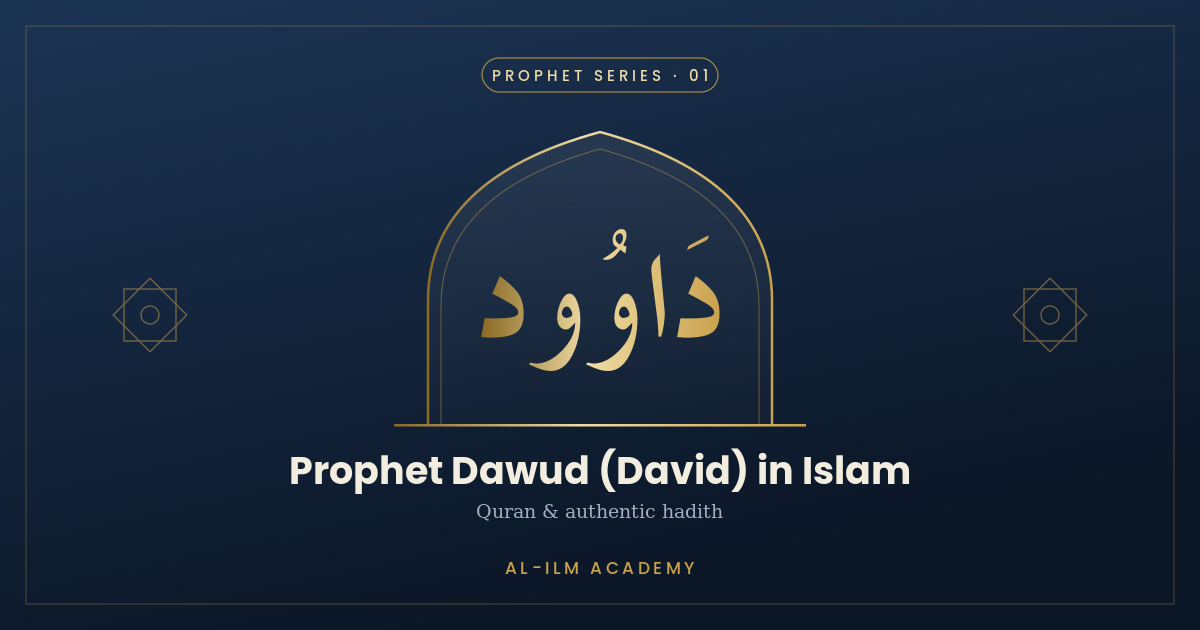
Prophet Dawud (David), peace be upon him, is one of the few figures in history to be given both prophethood and kingship. He killed Jalut (Goliath) as a young man, ruled Bani Israil with justice, received the Zabur, and was given gifts no one before or since has been given: mountains that echoed his praise of Allah, and iron that softened in his hands.
He is named sixteen times in the Qur’an, and the Prophet Muhammad (peace be upon him) held up his prayer, his fasting and his working life as the most beloved to Allah.
This article tells his story entirely from the Qur’an and authentic hadith, with every source linked. It also deals plainly with the one part of his story that is routinely told wrong online — a Biblical episode that Islamic scholarship rejects.
Quick Answer
- Dawud (David), peace be upon him, was a prophet and a king of Bani Israil, and the father of Prophet Sulaiman (Solomon).
- He killed Jalut (Goliath), after which “Allah blessed David with kingship and wisdom” — al-Baqarah 2:251.
- He was given the Zabur (Psalms) — al-Isra 17:55, an-Nisa 4:163.
- Allah subjected the mountains and birds to glorify Him with Dawud, and made iron mouldable for him so he could make armour — Saba 34:10–11.
- The most beloved prayer and fasting to Allah are those of Dawud: sleeping half the night, praying a third, and fasting every other day — Sahih al-Bukhari 1131.
- The Bathsheba story is not part of the Islamic account. Ibn Kathir identified it as Isra’iliyyat and refused to build the verses on it.
Who Was Prophet Dawud?
Dawud (peace be upon him) was a prophet of Bani Israil, a descendant of Ibrahim (peace be upon him), and the father of Sulaiman (peace be upon him), who inherited his prophethood and kingdom.
The Qur’an opens its fullest passage about him with a description worth pausing on:
اصْبِرْ عَلَى مَا يَقُولُونَ وَاذْكُرْ عَبْدَنَا دَاوُودَ ذَا الْأَيْدِ إِنَّهُ أَوَّابٌ
“Be patient ˹O Prophet˺ with what they say. And remember Our servant, David, the man of strength. Indeed, he ˹constantly˺ turned ˹to Allah˺.” — Surah Sad 38:17
Two titles in one verse. Dhal-ayd — “the man of strength,” physical and moral. And awwāb — one who returns, again and again, to Allah. The Qur’an gives him power and then immediately tells you what he did with it.
Dawud and Jalut: How a Young Man Became King
Before he was a king, Dawud was a soldier in the army of Talut (Saul). Facing the overwhelming force of Jalut (Goliath), the believers prayed for patience and firm footing — and then:
فَهَزَمُوهُم بِإِذْنِ اللَّهِ وَقَتَلَ دَاوُودُ جَالُوتَ وَءَاتَىهُ اللَّهُ الْمُلْكَ وَالْحِكْمَةَ وَعَلَّمَهُ مِمَّا يَشَاءُ
“So they defeated them by Allah’s Will, and David killed Goliath. And Allah blessed David with kingship and wisdom and taught him what He willed.” — al-Baqarah 2:251
Notice the sequence. The victory is credited to Allah’s permission first, and Dawud’s hand second. And the kingship is not something he seized — it is something he was given, along with wisdom, after he stepped forward when others hesitated.
The Qur’an does not describe a sling, five stones, or a shepherd boy’s taunt. Those details belong to the Biblical narrative. The Qur’anic account is deliberately spare: he killed Jalut, and Allah gave him everything that followed.
What Allah Gave to Dawud
The Zabur
“…and to David We gave the Psalms.” — al-Isra 17:55; see also an-Nisa 4:163
The Zabur is one of the four scriptures named in the Qur’an, alongside the Tawrah, the Injil and the Qur’an itself. Muslims believe it was revealed to Dawud (peace be upon him). The Qur’an does not tell us that the book known today as the Psalms is that revelation preserved intact.
Its recitation was made light for him. Abu Hurayrah (may Allah be pleased with him) reported that the recitation of the Zabur was made so easy for Dawud that he would order his mounts to be saddled, and finish reciting it before the saddling was done — Sahih al-Bukhari 3417.
Mountains and birds that glorified Allah with him
إِنَّا سَخَّرْنَا الْجِبَالَ مَعَهُ يُسَبِّحْنَ بِالْعَشِيِّ وَالْإِشْرَاقِ
وَالطَّيْرَ مَحْشُورَةً كُلٌّ لَّهُ أَوَّابٌ
“We truly subjected the mountains to hymn ˹Our praises˺ along with him in the evening and after sunrise. And ˹We subjected˺ the birds, flocking together. All turned to him ˹echoing his hymns˺.” — Surah Sad 38:18–19
The same miracle appears in Saba 34:10 — “O mountains! Echo his hymns! And the birds as well” — and in al-Anbiya 21:79.
This is a striking image: creation itself joining a human being in worship. It is also a comment on his voice, which was famously beautiful. The Prophet (peace be upon him) told Abu Musa al-Ash’ari (may Allah be pleased with him), after hearing him recite: “You have been given one of the flutes of the family of David” — Sahih al-Bukhari 5048.
Iron that softened in his hands
وَأَلَنَّا لَهُ الْحَدِيدَ
أَنِ اعْمَلْ سَابِغَاتٍ وَقَدِّرْ فِى السَّرْدِ
“We made iron mouldable for him, instructing: ‘Make full-length armour, ˹perfectly˺ balancing the links.'” — Saba 34:10–11
And in Surah al-Anbiya:
“We taught him the art of making body armour to protect you in battle. Will you then be grateful?” — al-Anbiya 21:80
Note what the miracle was for. Not treasure, not display — protective armour, and an instruction about craftsmanship: measure the links properly. Even the miracle came with a standard of workmanship attached.
Wisdom and decisive judgment
وَشَدَدْنَا مُلْكَهُ وَءَاتَيْنَاهُ الْحِكْمَةَ وَفَصْلَ الْخِطَابِ
“We strengthened his kingship, and gave him wisdom and sound judgment.” — Surah Sad 38:20
Faṣl al-khiṭāb — literally the ability to separate speech, to cut through a dispute to the decisive point. It was the working tool of his reign.
Dawud the Judge
Being given judgment did not mean being beyond correction. The Qur’an records a case where his son reached a better ruling:
“And ˹remember˺ when David and Solomon passed judgment regarding the crops ruined ˹at night˺ by someone’s sheep, and We were witness to their judgments. We guided ˹young˺ Solomon to a fairer settlement, and granted each of them wisdom and knowledge.” — al-Anbiya 21:78–79
Read verse 79 carefully. Sulaiman is guided to the better ruling — and both are described as given wisdom and knowledge. Dawud is not diminished. A judge can be wise, sincere and correct in principle, and still be surpassed on a particular question. That is a remarkably mature picture of authority.
The charge given to him is the verse that any person in a position of responsibility should sit with:
يَادَاوُودُ إِنَّا جَعَلْنَاكَ خَلِيفَةً فِى الْأَرْضِ فَاحْكُم بَيْنَ النَّاسِ بِالْحَقِّ وَلَا تَتَّبِعِ الْهَوَى فَيُضِلَّكَ عَن سَبِيلِ اللَّهِ
“O David! We have surely made you an authority in the land, so judge between people with truth. And do not follow ˹your˺ desires or they will lead you astray from Allah’s Way.” — Surah Sad 38:26
Authority, then the standard, then the warning — and the warning is not about enemies. It is about his own desires.
The Two Disputants — and What the Story Does Not Say
This is the passage most misrepresented online, so it deserves care.
Two men climbed the wall into Dawud’s private chamber. He was startled. They said they were in a dispute: one had ninety-nine sheep, the other only one, and the first had demanded the last one too. Dawud ruled for the wronged man — and then:
وَظَنَّ دَاوُودُ أَنَّمَا فَتَنَّاهُ فَاسْتَغْفَرَ رَبَّهُ وَخَرَّ رَاكِعًا وَأَنَابَ
فَغَفَرْنَا لَهُ ذَلِكَ وَإِنَّ لَهُ عِندَنَا لَزُلْفَى وَحُسْنَ مَـَٔابٍ
“Then David realized that We had tested him, so he asked for his Lord’s forgiveness, fell down in prostration, and turned ˹to Him in repentance˺. So We forgave that for him. And he will indeed have ˹a status of˺ closeness to Us and an honourable destination!” — Surah Sad 38:24–25
That is the whole account. The Qur’an does not say what the test was.
Search online and you will find the gap filled with the Biblical story of David, Bathsheba and Uriah — adultery and arranged death. This is not the Islamic account, and classical Islamic scholarship rejected importing it.
Ibn Kathir, commenting on exactly these verses, wrote:
“In discussing this passage, the scholars of Tafsir mention a story which is mostly based upon Isra’iliyat narrations. Nothing has been reported about this from the Infallible Prophet that we could accept as true… So, it is better to speak briefly of this story and refer knowledge of it to Allah, may He be exalted. For the Qur’an is true and what it contains is also true.”
— Tafsir Ibn Kathir on Surah Sad 38:21–25
He notes that the one hadith cited for it, narrated by Yazid ar-Raqashi from Anas, has a chain that cannot be regarded as sahih.
There is also a matter of principle. Muslims hold that the prophets were protected by Allah from major sins. Reading a capital crime into a verse that does not mention one, on the strength of a rejected narration, is not interpretation — it is substitution.
What the verses do show is a prophet who, the moment he suspected he had been tested, fell into prostration and turned to Allah. That is the lesson the passage was given for.
The prostration in Surah Sad
Verse 24 carries a prostration of recitation (sajdat at-tilāwah). Ibn Abbas (may Allah be pleased with him) reported that the Prophet (peace be upon him) said of it:
“Dawud prostrated it as an act of repentance, and we prostrate it as an act of thanks.”
Ibn Kathir notes that this prostration is not among the obligatory ones — it is a prostration of gratitude — and that the Prophet (peace be upon him) performed it. (Tafsir Ibn Kathir, Surah Sad)
The Worship and Working Life of Dawud
Here the Sunnah is unusually specific, and unusually practical.
His prayer and fasting. Abdullah ibn Amr ibn al-As (may Allah be pleased with him) reported that the Prophet (peace be upon him) said:
“The most beloved prayer to Allah is that of David, and the most beloved fasts to Allah are those of David. He used to sleep for half of the night, then pray for a third of the night, and again sleep for a sixth of it; and he used to fast on alternate days.”
This is the origin of sawm Dawud — fasting every other day — which the Prophet (peace be upon him) described elsewhere as the most excellent fasting, precisely because it is sustainable. A pattern you can keep for life beats an intensity you abandon in a month.
His livelihood. Abu Hurayrah (may Allah be pleased with him) reported:
“The Prophet David used not to eat except from the earnings of his manual labour.”
A king with a treasury at his disposal ate only from the armour he made with his own hands.
Lessons from the Life of Dawud
- Power is a trust, not a prize. The kingship was given, and immediately fastened to a command to judge by the truth.
- The danger to a just ruler is internal. “Do not follow your desires” (38:26) — not “beware your enemies.”
- Being corrected is not being diminished. Sulaiman reached the better ruling, and Allah still praises both.
- Strength and repentance belong together. He is dhal-ayd and awwāb in the same verse.
- Consistency beats intensity. Half the night’s sleep, a third in prayer, fasting every other day — a rhythm that lasts.
- Honest work is honourable at every rank. He could have eaten from the treasury. He ate from his own hands.
Frequently Asked Questions
Who was Prophet Dawud in Islam?
Dawud (David), peace be upon him, was a prophet and king of Bani Israil and the father of Prophet Sulaiman (Solomon). He killed Jalut (Goliath), was given kingship, wisdom and the Zabur, and is named sixteen times in the Qur’an.
What book was revealed to Prophet Dawud?
The Zabur, usually rendered as the Psalms. It is named in al-Isra 17:55 and an-Nisa 4:163 and is one of the four scriptures the Qur’an names.
What miracles was Prophet Dawud given?
Allah subjected the mountains and the birds to glorify Him along with Dawud, made iron mouldable in his hands so he could fashion armour, gave him a beautiful voice, and granted him wisdom and decisive judgment (Sad 38:18–20, Saba 34:10–11, al-Anbiya 21:79–80).
What is the fast of Dawud?
Fasting on alternate days — one day fasting, the next not. The Prophet (peace be upon him) called it the fasting most beloved to Allah (Sahih al-Bukhari 1131).
What was the prayer of Dawud?
He would sleep for half the night, pray for a third of it, then sleep for the remaining sixth — described in the same hadith as the prayer most beloved to Allah.
Did Prophet Dawud commit a sin with Bathsheba?
No. That episode is from the Biblical narrative and forms no part of the Qur’anic account. Ibn Kathir identified the material as Isra’iliyyat with no authentic prophetic basis and declined to interpret the verses through it. The Qur’an says only that Dawud realised he had been tested, sought forgiveness and prostrated — without specifying the test.
Is Prophet Dawud the same as King David in the Bible?
They refer to the same historical figure, but the accounts differ in significant ways. The Qur’an presents Dawud as a prophet of Allah, protected from major sin, and omits several episodes found in the Biblical text.
How many times is Dawud mentioned in the Quran?
Sixteen times by name, across surahs including al-Baqarah, an-Nisa, al-Maidah, al-Anam, al-Isra, al-Anbiya, an-Naml, Saba and Sad.
Sources
Every claim above can be checked. Primary sources used:
Qur’an
- al-Baqarah 2:251 — Dawud kills Jalut; kingship and wisdom given
- an-Nisa 4:163 and al-Isra 17:55 — the Zabur
- al-Anbiya 21:78–80 — the case of the crops; mountains and birds; the art of armour
- Saba 34:10–11 — iron made mouldable; the command about the links
- Sad 38:17–26 — the fullest passage: strength, repentance, kingship, the two disputants, the charge to judge justly
Hadith
- Sahih al-Bukhari 1131 — the prayer and fasting of Dawud
- Sahih al-Bukhari 2073 — eating only from the work of his own hands
- Sahih al-Bukhari 3417 — the recitation of the Zabur made easy for him
- Sahih al-Bukhari 5048 — “one of the flutes of the family of David”
Tafsir
- Tafsir Ibn Kathir on Surah Sad 38:21–25 — on the Isra’iliyyat material and on the prostration in Surah Sad
Read the Story in the Original
The passage about Dawud in Surah Sad is one of the most powerful in the Qur’an — and reading it in Arabic, understanding the difference between dhal-ayd and awwāb, is a completely different experience from reading a translation.
Al-Ilm Academy offers one-to-one online Quran, Tajweed and Tafsir classes with qualified male and female teachers, at times that fit around work and school. Your first class is free.
👉 Book your free trial class at Al-Ilm Academy and read the stories of the Prophets as they were revealed, in shā’ Allah.
Want to Master Quran Recitation & Tajweed Live?
Join Al-Ilm Academy today and learn 1-on-1 with Ijazah-certified male and female tutors tailored to your schedule.
Reviewed by Al-Ilm Academic Panel
Onais Khan & Certified Senior Scholars
This guide was produced and reviewed by certified Quran reciters and Arabic linguists at Al-Ilm Academy to ensure authentic Islamic guidance.
📚 Recent Articles
-
How to Find the Best Cheap Umrah Packages in 2026 Sep 16, 2026