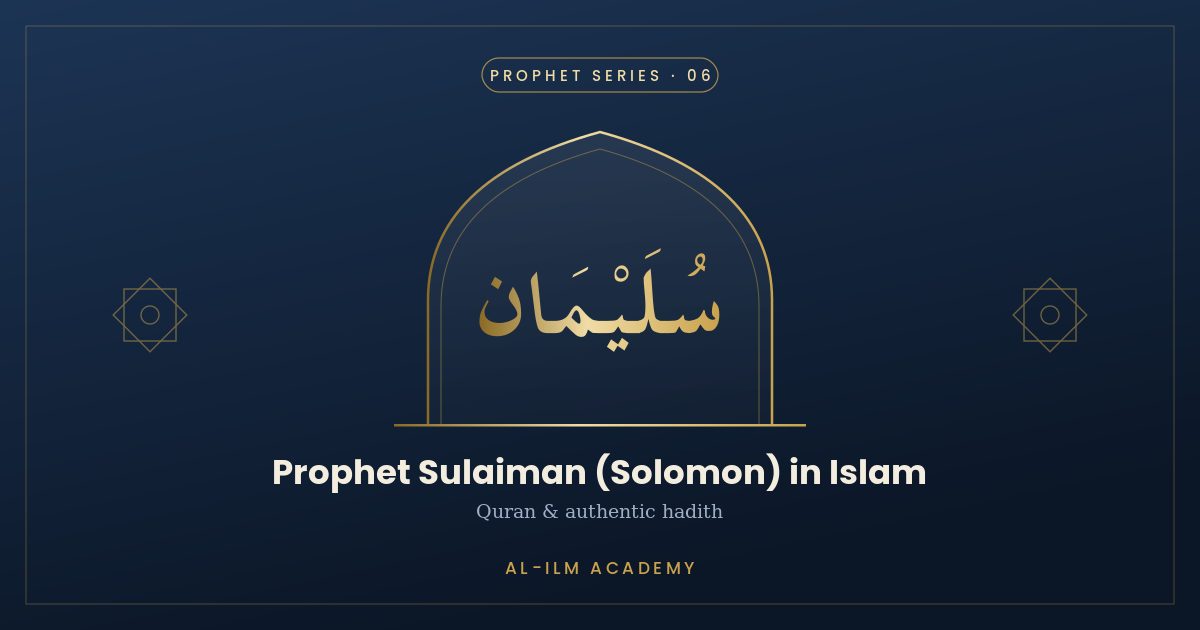
Prophet Sulaiman (Solomon), peace be upon him, was given a kingdom unlike any before or since: the wind at his command, jinn labouring under him, and the ability to understand the speech of birds and ants.
He was also, uniquely among the prophets, the subject of a slander that Allah answered directly in the Qur’an. Magic had become attached to his name — and al-Baqarah 2:102 states flatly: “Never did Solomon disbelieve.”
That defence matters more today than most people realise, because his name is still attached to occult traditions he had nothing to do with. This article gives his story from the Qur’an, with every passage linked — and deals with the sorcery question head-on.
Quick Answer
- Sulaiman (Solomon), peace be upon him, was a prophet and king, the son of Prophet Dawud (David), who inherited his father’s prophethood and kingdom (an-Naml 27:16).
- He was taught the speech of birds and given command over jinn, humans and birds (an-Naml 27:16–17).
- The wind was subjected to him — a month’s journey in a morning, a month in an evening — and molten copper flowed for him (Saba 34:12).
- He asked Allah for a kingdom no one after him would have, and it was granted (Sad 38:35).
- The Qur’an explicitly clears him of sorcery: “Never did Solomon disbelieve, rather the devils disbelieved” (al-Baqarah 2:102).
- His death proved the jinn do not know the unseen — they kept working until a creature ate through his staff and he fell (Saba 34:14).
Who Was Prophet Sulaiman?
Sulaiman (peace be upon him) was the son of Prophet Dawud (David), and like his father he was given both prophethood and rule. The Qur’an introduces them together:
وَلَقَدْ آتَيْنَا دَاوُودَ وَسُلَيْمَانَ عِلْمًا وَقَالَا الْحَمْدُ لِلَّهِ الَّذِي فَضَّلَنَا عَلَى كَثِيرٍ مِّنْ عِبَادِهِ الْمُؤْمِنِينَ
“Indeed, We granted knowledge to David and Solomon. And they said ˹in acknowledgment˺, ‘All praise is for Allah Who has privileged us over many of His faithful servants.'” — an-Naml 27:15
Notice what they were given first: knowledge. Not the wind, not the jinn — knowledge. And notice their response to it: praise.
وَوَرِثَ سُلَيْمَانُ دَاوُودَ وَقَالَ يَا أَيُّهَا النَّاسُ عُلِّمْنَا مَنطِقَ الطَّيْرِ وَأُوتِينَا مِن كُلِّ شَيْءٍ إِنَّ هَذَا لَهُوَ الْفَضْلُ الْمُبِينُ
“And David was succeeded by Solomon, who said, ‘O people! We have been taught the language of birds, and been given everything ˹we need˺. This is indeed a great privilege.'” — an-Naml 27:16
He announces the gift publicly — and names it as faḍl, a favour granted, not an achievement earned.
The Kingdom He Asked For
Sulaiman made a request that would sound like arrogance from anyone else:
قَالَ رَبِّ اغْفِرْ لِي وَهَبْ لِي مُلْكًا لَّا يَنبَغِي لِأَحَدٍ مِّن بَعْدِي إِنَّكَ أَنتَ الْوَهَّابُ
“He prayed, ‘My Lord! Forgive me, and grant me an authority that will never be matched by anyone after me. You are indeed the Giver ˹of all bounties˺.'” — Sad 38:35
Read the order of that dua. Forgiveness first, kingdom second. And it closes by naming Allah as al-Wahhāb — the Giver — which frames the whole request as something only Allah can grant, not something Sulaiman could take.
What he was given:
The wind. “Its morning stride was a month’s journey and so was its evening stride” (Saba 34:12).
Molten copper, made to flow like a spring — the industrial base of his kingdom.
The jinn, working under him by Allah’s permission, building “sanctuaries, statues, basins as large as reservoirs, and cooking pots fixed into the ground” (Saba 34:13).
Armies of jinn, humans and birds, “perfectly organized” (an-Naml 27:17).
And immediately after listing all of it, the Qur’an issues a command that punctures any triumphalism: “Work gratefully, O family of David! ˹Only˺ a few of My servants are ˹truly˺ grateful” (34:13).
The Ant
The most famous moment of his reign involves the smallest creature in it. Sulaiman’s army was on the march:
حَتَّى إِذَا أَتَوْا عَلَى وَادِ النَّمْلِ قَالَتْ نَمْلَةٌ يَا أَيُّهَا النَّمْلُ ادْخُلُوا مَسَاكِنَكُمْ لَا يَحْطِمَنَّكُمْ سُلَيْمَانُ وَجُنُودُهُ وَهُمْ لَا يَشْعُرُونَ
“And when they came across a valley of ants, an ant warned, ‘O ants! Go quickly into your homes so Solomon and his armies do not crush you, unknowingly.'” — an-Naml 27:18
The ant’s warning is remarkably fair-minded: it does not accuse Sulaiman of cruelty. It says wa hum lā yashʿurūn — without their realising. Even in danger, it does not slander the prophet.
And Sulaiman’s response is the heart of the passage:
فَتَبَسَّمَ ضَاحِكًا مِّن قَوْلِهَا وَقَالَ رَبِّ أَوْزِعْنِي أَنْ أَشْكُرَ نِعْمَتَكَ الَّتِي أَنْعَمْتَ عَلَيَّ وَعَلَى وَالِدَيَّ وَأَنْ أَعْمَلَ صَالِحًا تَرْضَاهُ وَأَدْخِلْنِي بِرَحْمَتِكَ فِي عِبَادِكَ الصَّالِحِينَ
Transliteration: Rabbi awziʿnī an ashkura niʿmatakal-latī anʿamta ʿalayya wa ʿalā wālidayya wa an aʿmala ṣāliḥan tarḍāh, wa adkhilnī biraḥmatika fī ʿibādika-ṣ-ṣāliḥīn.
“So Solomon smiled in amusement at her words, and prayed, ‘My Lord! Inspire me to ˹always˺ be thankful for Your favours which You have blessed me and my parents with, and to do good deeds that please you. Admit me, by Your mercy, into ˹the company of˺ Your righteous servants.'” — an-Naml 27:19
A king at the head of an army of jinn and men overhears an insect, smiles, and immediately asks to be made grateful — and to be admitted among the righteous by mercy, not by merit. It is one of the most quoted duas in the Qur’an, and it is worth memorising.
The Hoopoe and the Queen of Sheba
The longest episode of Sulaiman’s reign begins with a roll-call. He notices a bird missing — the hoopoe — and says he will punish it severely unless it brings a clear excuse (an-Naml 27:20–21).
The hoopoe returns with news: a people in Saba (Sheba) ruled by a queen, worshipping the sun. Sulaiman’s response is instructive — he does not accept the report on trust. “We will see whether you are truthful or a liar” (an-Naml 27:27).
He sends a letter. Its opening is famous:
“It is from Solomon, and it reads: ‘In the Name of Allah—the Most Compassionate, Most Merciful.'” — an-Naml 27:30
What follows is a study in statecraft and restraint. The queen consults her chiefs, who remind her of their military strength; she replies that kings ruin a land when they enter it. She sends a gift instead — and Sulaiman refuses it, because he was not seeking tribute (an-Naml 27:32–37).
Then her throne is brought to him before she arrives — “before your glance returns to you”, said one who had knowledge of the Scripture — and Sulaiman’s reaction is again the point: “This is by the grace of my Lord to test me whether I am grateful or ungrateful” (an-Naml 27:40).
She arrives, mistakes the polished glass floor for water, and then says the line the whole episode was building to: “My Lord! I have certainly wronged my soul. Now I submit, along with Solomon, to Allah, the Lord of all worlds” (an-Naml 27:44).
A note on her name. The Qur’an never names her. She is “a woman ruling over them” (27:23). The name Bilqis comes from later tradition, not from the Qur’an.
“Never Did Solomon Disbelieve”
This is the part of his story most worth reading carefully.
By the time of the Prophet Muhammad (peace be upon him), a body of magical literature had attached itself to Sulaiman’s name — the claim that his kingdom had been built on sorcery. The Qur’an answers it directly:
وَاتَّبَعُوا مَا تَتْلُو الشَّيَاطِينُ عَلَى مُلْكِ سُلَيْمَانَ وَمَا كَفَرَ سُلَيْمَانُ وَلَكِنَّ الشَّيَاطِينَ كَفَرُوا يُعَلِّمُونَ النَّاسَ السِّحْرَ
“They ˹instead˺ followed the magic promoted by the devils during the reign of Solomon. Never did Solomon disbelieve, rather the devils disbelieved. They taught magic to the people…” — al-Baqarah 2:102
Three things are established in that one verse:
- The magic was real and was circulating — the Qur’an does not deny that people practised it.
- It came from the devils, not from Sulaiman. The attribution to him was false.
- Sulaiman did not disbelieve. The Arabic wa mā kafara Sulaymān is a flat, categorical denial.
The same verse goes on to say that what people learned “harmed them and did not benefit them”, and that whoever buys into magic “would have no share in the Hereafter.”
Why this still matters. Sulaiman’s name remains attached to seals, talismans, rings and grimoires in occult traditions across several cultures — “the Seal of Solomon”, “the Key of Solomon”, and so on. None of this has any basis in the Qur’an, and all of it runs against the verse that cleared him. A prophet whose miracles were granted by Allah is not a patron of sorcery. Anyone selling an amulet on his authority is doing precisely what 2:102 describes.
How Sulaiman Died
The manner of his death is recorded in the Qur’an for a specific theological reason:
فَلَمَّا قَضَيْنَا عَلَيْهِ الْمَوْتَ مَا دَلَّهُمْ عَلَى مَوْتِهِ إِلَّا دَابَّةُ الْأَرْضِ تَأْكُلُ مِنسَأَتَهُ فَلَمَّا خَرَّ تَبَيَّنَتِ الْجِنُّ أَن لَّوْ كَانُوا يَعْلَمُونَ الْغَيْبَ مَا لَبِثُوا فِي الْعَذَابِ الْمُهِينِ
“When We decreed Solomon’s death, nothing indicated to the ˹subjected˺ jinn that he was dead except the termites eating away his staff. So when he collapsed, the jinn realized that if they had ˹really˺ known the unseen, they would not have remained in ˹such˺ humiliating servitude.” — Saba 34:14
He died leaning on his staff, and the jinn kept labouring — for how long, the Qur’an does not say — until the wood gave way.
The verse states its own lesson: the jinn do not know the unseen. They could not tell that the man they served had died in front of them. Any claim that jinn can reveal hidden knowledge, tell fortunes or predict the future is answered by this verse.
What the Qur’an Does Not Say
- The Queen of Sheba is not named. “Bilqis” is from later tradition.
- There is no ring. The famous story of a ring in which Sulaiman’s power resided, stolen by a demon who then impersonated him, is not in the Qur’an. It grew up around the brief and undetailed verse Sad 38:34, and much of the material is Isra’iliyyat that classical scholars treated with caution.
- The duration of his reign, the location of his kingdom, the length the jinn kept working after his death — none are specified.
- No magical text, seal or formula is attributed to him. The opposite is stated.
Lessons from the Life of Sulaiman
- Knowledge came before the kingdom — and praise came before both.
- Ask for forgiveness first. Even in a dua for unmatched power, he began with “forgive me.”
- Great power is a test of gratitude, not a proof of favour. He says so himself when the throne appears.
- Listen to the smallest voice in the room. He halted an army because an ant spoke.
- Verify before you act. He would not take even the hoopoe’s report without checking it.
- Invitation beats conquest. He sent a letter, refused tribute, and won a believer rather than a province.
- No one, however powerful, knows the unseen. Not the jinn who served him, and not those who claim their authority today.
Frequently Asked Questions
Who was Prophet Sulaiman in Islam?
Sulaiman (Solomon), peace be upon him, was a prophet and king, the son of Prophet Dawud. He inherited his father’s prophethood and kingdom, was taught the speech of birds, and was given command over the wind and over jinn by Allah’s permission.
What miracles was Prophet Sulaiman given?
Command of the wind, a flowing spring of molten copper, jinn working under him, understanding of the speech of birds and ants, and armies of jinn, humans and birds (Saba 34:12–13, an-Naml 27:16–17).
What is the dua of Prophet Sulaiman?
The best known is his prayer after hearing the ant: Rabbi awziʿnī an ashkura niʿmatakal-latī anʿamta ʿalayya wa ʿalā wālidayya… — “My Lord! Inspire me to always be thankful for Your favours which You have blessed me and my parents with…” (an-Naml 27:19). He also prayed for forgiveness and an unmatched kingdom in Sad 38:35.
Was Prophet Sulaiman a magician?
No — and the Qur’an says so explicitly. “Never did Solomon disbelieve, rather the devils disbelieved” (al-Baqarah 2:102). The magic circulating in his name came from devils, not from him. The occult traditions that use his name have no basis in the Qur’an.
Who was the Queen of Sheba in the Quran?
A queen who ruled a sun-worshipping people in Saba, who received Sulaiman’s letter, tested him with a gift, visited him, and declared her submission to Allah (an-Naml 27:22–44). The Qur’an does not name her; the name Bilqis comes from later tradition.
How did Prophet Sulaiman die?
He died leaning on his staff, and the jinn working for him did not realise until a creature of the earth ate through the staff and he fell. The Qur’an records this to show that the jinn do not know the unseen (Saba 34:14).
Did Prophet Sulaiman control jinn?
Yes — but by Allah’s permission and by Allah’s granting, as the verse states explicitly: “some of the jinn to work under him by his Lord’s Will” (Saba 34:12). It was a miracle given to a prophet, not a technique available to anyone else.
Is the ring of Solomon in the Quran?
No. The story of a ring holding his power, and a demon who stole it and impersonated him, is not in the Qur’an. It developed around the very brief Sad 38:34, and much of the surrounding material is Isra’iliyyat.
Sources
Every claim above can be checked. Primary sources used:
Qur’an
- al-Baqarah 2:102 — “Never did Solomon disbelieve”
- an-Naml 27:15–19 — knowledge, inheritance, the armies, the ant, and his dua
- an-Naml 27:20–44 — the hoopoe, the letter, the Queen of Sheba
- Saba 34:12–14 — the wind, molten copper, the jinn, and his death
- Sad 38:35 — his dua for forgiveness and a kingdom
- Sad 38:34 — the brief verse around which the ring stories grew
Continue the Series
This is article 06 in our Prophet Series. Read Prophet Dawud (David) — Sulaiman’s father — and Prophet Ishaq (Isaac), Prophet Lut (Lot) and Prophet Musa (Moses).
Read the Story in the Original
Surah an-Naml gives Sulaiman’s reign in a single sweep — the ant, the hoopoe, the letter, the throne, the glass floor. Reading it in Arabic, hearing fatabassama ḍāḥikan — “so he smiled, laughing” — at the moment a king overhears an insect, is a different experience from any translation.
Al-Ilm Academy offers one-to-one online Quran, Tajweed and Tafsir classes with qualified male and female teachers, at times that fit around work and school. Your first class is free.
👉 Book your free trial class at Al-Ilm Academy and read the stories of the Prophets as they were revealed, in shā’ Allah.
Want to Master Quran Recitation & Tajweed Live?
Join Al-Ilm Academy today and learn 1-on-1 with Ijazah-certified male and female tutors tailored to your schedule.
Reviewed by Al-Ilm Academic Panel
Onais Khan & Certified Senior Scholars
This guide was produced and reviewed by certified Quran reciters and Arabic linguists at Al-Ilm Academy to ensure authentic Islamic guidance.
📚 Recent Articles
-
How to Find the Best Cheap Umrah Packages in 2026 Sep 16, 2026